Friday, July 10, 2009

Amazing Spain

I've returned last week from the most incredible 35-day trip, where I spent two days in France, and the remainder in Spain. My main objective was to walk/backpack the 800km Camino Francés that starts in Saint-Jean-Pied-de-Port France and ends in Santiago the Compostella Spain. I had planned 29 walking days for this trek. Things went so well in fact that I was able to cover the distance in 28. Just incredible weather, sunshine almost every day, with only about 6 hours of rain while I was walking. The landscape was breathtaking, on certain days it felt as if I was walking through a picture Post Card. So much history has occurred on this route that dates more than a millennium.


The fraternity between pilgrims was like nothing I had ever experienced. At times, it felt like a meeting of the United Nations. I made so many great friends, made so many connections. The warmth of the local Spanish people was equally remarkable. I was lucky to have been spared any major injuries, only 3 tiny blisters. On the final walking day, my marathon running past came back to haunt me, so I opted to walk the marathon distance of 42,2km (well actually, it was 42,6km) , which made it even more significant for me. It was a journey of a life time, one for the ages.


Any travel would not be complete without taking advantage of the art along the way. After landing in Toulouse France, I was off to visit the city. My art stops included la Salle des Illustes at the Capitale (city hall). Here, gigantic mural-like impressionist paintings of Henri Martin and Paul Gervais adorn the walls. In the hall next door, a civil wedding was taking place, after which the bridal party had their picture taken in front of the Gervais masterpieces with a theme of love and marriage. I was then off to l'Hôtel d'Assézat, home of the Foundation Bemberg and it's excellent collection of paintings ranging from Toulouse-Lautrec, Manet, Monet, Degas, R, Duffy, Gauguin and especially Pierre Bonnard of which there was at least 3 dozen paintings. All housed in the city's most elegant Renaissance mansion built in 1555 by Nicholas Bachelier.


Along the Camino, the art could be found mostly in the hundreds of churches. Some ranging from the size of a small chapel to the most elaborate, sophisticated and largest Gothic church I have ever seen, the Cathedral of Santa Maria in Burgos, built over a 400 year period. The above photo is only a portion of the structure. It has to be seen, as no words can quite describe it. There is an enormous amount of wealth in these institutions. It is impossible not to marvel at the talented individuals who created the frescoes, paintings, wood and stone carvings, sculptures, architecture and overall craftsmanship found here.


I also had the opportunity to visit the very colorful Museo de Arte Contemporaneo de Castilla y Leon. The MUSAC is the most important contemporary museum in the province of Leon. While in Santiago de Compostella, I visited the Centre Galego de Arte Contempranea, another large multi level space. Exhibitions in contemporary art galleries either cater to geniuses creating innovative conceptual art and installations and/or on the obscure, avant-garde, issues dealing with censorship, morality, underground culture, often explicit and graphic material, to push your buttons and at time to shock you. Well, these were no different even if they were on the route of the third most holiest pilgrimage in Christianity. Admission is free, meaning that these institutions are government funded. When Andy Warhol said, ''Art is what you can get away with''.......he was right!!!


But my real ''Coup de coeur'' happened in Madrid, where I spent 3 days sight-seeing before returning home. It happened at the Museo Sorolla. Joachin Sorolla (1863-1923) was a Spanish born impressionist painter who lived in Madrid. In 1932, his exquisite home and studio was transform into a museum following his death. I can't really recall seeing any of his work except in art books. As you pass through the street gate that leads you into a wonderful enchanted garden, the experience of stepping into his world has already begun. While entering the third of interconnected studios spaces where he painted, my jaw dropped and at that moment he went from being an obscure painter to one of my all-time favorite. In the larger room with a vaulted ceiling, paintings were hung salon style, his paint box and brushes were all there. A creative space that exuded a palpable energy. The museum continues on the ground level into the living and dining room of his residence and for another four rooms on the second floor. There was easily 80 paintings in all on display.


As luck would have it, my newly found admiration for Sorolla's work would reach a climax, as the Museo del Prado was hosting a major retrospective of his work until September 6. My admission ticket even had a pre-set viewing time, as the entire space was elbow to elbow. In the first room, the instant I saw the very fair-skin female nude seated on a marble base that can be seen on this link , I instantly became teary eyed. I knew I was in the presence of a genius. The way he paints light, the whites, his use of pastel colors, the contrasts, his compositions and subject matter really sets him apart. It's moments like these are when you can truly connect with art and see how it contribute to society and becomes an essential part of what it means to feel alive.
All of the figures studies set along the shoreline and marine paintings with the wind blowing in the white canvas sails that has light coming from behind, becoming illuminated in both pastel and the darker contrasting shadows being cast from the masts and the folds......well, they just took my breath away.

The Prado Museum has one of the finest collection of European art from the 12th to the early 19th century, featuring spanish master painters from the golden age - Goya, El Greco and Diego Velazquez, who's painting ''Las Meninas'' is considered by some as the most famous painting in the world. For the most part, the art found here are mostly Academic paintings. In all, I spent 4½ hours there.


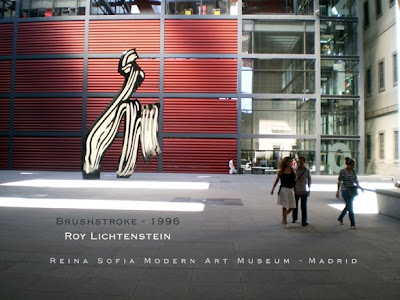
After El Prado comes the Museo Nacional Centro de Arte Reina Sofia, Spain's national museum of 20th century art. Several temporary exhibits included a compelling retrospective of Juan Munoz and the permanent collection that includes many Salvador Dali, Pablo Picasso, Joan Miro, Guillermo Perez Villata, Sigfrido Martin Begué to name a few. Outside the Reina Sofia is the enormous sculptural work entitled ''Brushstroke'' by Roy Lichtenstein as shown above.


The masterpiece of Reina Sofia is Picasso's Guernica as shown above. The mural size painting had a whole room to itself, and was jam-packed with people. I only got to view the painting from a side angle.


The last of the Golden Triangle of Art is the Thyssen-Bornemisza Museum that also includes the Carmen Thyssen-Bornemisza Collection. For it's overall collection, this one was my favorite. It houses a very impressive collection of old Flemish and Dutch masters, and an equally impressive list of international artists like John Singer Sargent, Marc Chagall, Childe Hassem, William Merritt Chase, Edward Hopper, Winslow Homer, Claude Monet, Auguste Renoir, Edgar Degas, Piet Mondrian, Lucian Freud....just to name a few. And what could be better than a Richard Estes painting.....how about three. And of course a retrospective of the brilliant French impressionist painter, Henri Matisse.

Sunday, May 10, 2009

Solo Show at Handworks Gallery


''Home Preserves'' - 16 x 16''
Acrylic on gessoed hardboard
April 13-21, 2009, #158


I am currently preparing a solo exhibition at Handworks Gallery in Saint John, NB. The show will be entitled ''NEAR & FAR'' and will run from October 16-30, 2009. It is a very broad title, so I have a lot of breathing space to explore the theme. Are we there yet? (2008) is the initial piece to jump start the show, the rest of the collection will feature all new paintings. The fun part of preparing a solo show is that it permits you to create a visual narrative and link images together. I will be aiming for 24 paintings, 16 large and 8 smaller pieces.
I will start previewing the new paintings about one month before the opening date. The above painting is the first installment and posted as a sneak peek, except that I've opted to display it in Black & White. I will be posting Home Preserves again in September in full colour. I am currently working on painting number 5, and so far so good....the last two are among my all-time favorites.
During the next few months, I will continue to post recent paintings completed prior to 2007 (birth of this Blog) and update the painting count for the solo show.

Wednesday, April 8, 2009

Sparkling Treasures

Acrylic polymer emulsion on gessoed hardboard, 14 x 20''
Created March 24- April 7, 2009, #157

This is a commission piece. It is yet another glass on glass study set on a grid wood storage cube with a sheet of tempered glass on top. This is the reason the base is so pale in color, light is being refracted. When they chose this particular image among the few hundreds I took, I agreed to honor their wishes, because it had the punch of colors they wanted, and the red plate was a family heirloom that was special to them both.

When I did the photo shoot, I knew that if they chose this type of imagery, it would in turn be setting the bar very high, like a high jumper going for a personal best by 10 cm. I procrastinated during the past year of painting too quickly because I knew I had this particular image to tackle. In retrospect I should have started with this one in order to put any doubt to rest, because the moment I started the pencil drawing, I realized that I could paint it. Even if it was the most complex glass piece I had ever done, if I isolated the image in small areas, it all made sense. Needless to say, I am pleased of this piece and the whole series. It was a great privilege for me to do these paintings and it was only fitting that they got to chose the title for the last piece.
-Private collection

Wednesday, March 25, 2009

Losing my marbles

Acrylic polymer emulsion on gessoed hardboard, 14 x 20''
Created - February 20- March 24, 2009. #156.

This painting was somewhat challenging on a cerebral level. I spent three days on the drawing alone. With just pencil lines and no contrasting definition, I kept getting lost in the lines around the rim of the mason jar that it lying on it's side. I always use a grisaille technique with Payne's grey acrylic paint. Once the paint has dried and cured, I them apply the colors on top in transparent layers. My goal is always to try to pull it off with my signature bright colors.

In this case, for the exception of the marbles and the out of focus greenery on the bottom, it was pretty much a monochromatic type of imagery. In the end it did work out, as the main focus here was to showcase the marbles with this glass on glass study. The jars may appear to be floating, but they are actually on a glass pane shelf that is recessed in a deep window. I had not painted this large in a year, and working on a flat surface is always a challenge in itself. I've had this title on the back burner for a while, it seemed like a propos painting to use it on.

-SOLD

Thursday, February 19, 2009

Wine Tasting

 Acrylic polymer emulsion on gessoed hardboard, 12 x 10''
Created January 17 - February 19, 2009, # 155

It has been a while since my last posting. After the Christmas Holiday, I did a complete make-over of our basement, which also included my studio. I am extremely pleased with the outcome. So after a one month hiatus from my brushes, this type of imagery is always intimidating when I am not painting on a daily basis. It's a process of defining, redefining and what seems like an endless series of tiny details.

In this windowsill still life, we find three completely different wines. Aufkellereien, is the German white wine as previously painted in Cheers. An Australian Shiraz, also known as Syrah. A dark skin variety of grape is used in this blend with a bouquet of ripe cherries, strawberries, spice and vanilla oak aroma. Yellow Tail Wines is bottled by Casella Wines . Completing the trio is a Gewürztraminer Ice wine. Gewürztraminer is an aromatic wine grape variety that performs best in cooler climates. This 2005 vintage was bottled by Sumac Ridge, a winery near Summerland, in the Okanagan Valley of British Columbia. 2005 was a very hot year with high brix levels resulting in an abundant fruit character. The grapes were picked at less than minus 8 degrees Celsius and underwent a slow cold fermentation for 45 days. The word Brix is used in the food industry for measuring the approximate amount of sugars in fruits, vegetables, juices, wine, soft drinks and in the sugar manufacturing industry.

We did a road trip of BC and Alberta in 2007 and drove through the beautiful Okanagan Valley where we visited the Burrowed Owl Estate Winery in Oliver. The wine was great, and the scenery was breathtaking.
-SOLD

Sunday, December 21, 2008

Yellow orchid in bloom


Acrylic polymer emulsion on wrapped canvas, 8 x 8''
Created December 10-17, 2008, #154


I do have a fascination with botanical in general. Five weeks ago, we purchased an Amaryllis bulb at Home Depot to add more festive colors in our home for Christmas. Two weeks later, it had sprouted about 4 inches. It now measures 25'', and has 5 large candy-cane stripped blooms on top at go 360 degrees. It just makes me stop in my tracks to look at it every time I pass near the foyer.


Orchid have the same effect on me. They usually last several weeks and if lucky, even several months. They have a Zen quality that brings balance and harmony to it's surroundings. What appealled to me in this image was the 3-sided view of the blooms - front, side & back. This is my only painting done on canvas this year, and a bit more tricky to paint than on gessoed hardboard.


This painting will be part of the Ability New Brunswick Art Auction held in Fredericton, NB - 
November 2014 - Details to follow. 
-SOLD

Thursday, December 18, 2008

Reflecting on being Acadian

Acrylic on gessoed hardboard, 12 x 12''Created Dec. 6-14, 2008, #153

Continuing my author/book series, this one is especially sweet. One of my favorite non-fiction books with the bonus of having one of my favorite artist on the cover.

I read Notes from Exile on being Acadian by Clive Doucet during the summer of 2002, in the wake of painting a piece entitled ''Fort Beauséjour'' that would become part of the permanent collection of Le musée acadien du Québec à Bonventure, Qc. (the Acadian Museum of Quebec) where I was fortunate enough to have a solo exhibition during that fall.

Notes from Exile recalls the journey of the author who was acting as a journalist for CBC radio during ''Les Retrouvailles'', the first World Acadian Congress and reunion that was held in south-eastern region of New Brunswick in 1994. It is an incisive, charming, touching and sometime witty account while he wrestles with the question of his own identity of being a Canadian with an Acadian father and a British mother. It left me with an enlightened sense of pride of my own personal identity and hertiage of being an Acadian. Notes from Exile is listed in the top 100 titles of it's publisher, McClelland and Stewart Inc.

The Acadians were the first French settlers to arrive to the New World back in 1604. The first settlement was established at Saint-Croix Island in the Bay of Fundy located on the New Brunswick / Maine border. A year later they would move to the mainland at Port Royal in Nova Scotia. The Acadians later established themselves in parts of what is now New Brunswick, Prince Edward Island, parts of eastern Quebec and the New England seaboard. British colonists captured Acadia in the course of Queen Anne's War (1702–1713), and its conquest was confirmed in the Treaty of Utrecht (1713). The French residents of Acadia were given one year to declare allegiance to Britain or leave N.S. In the meantime, the French signalled their preparedness for future hostilities by beginning the construction of Fortress Louisbourg on Isle Royale, now Cape Breton Island. The British grew increasingly alarmed by the prospect of disloyalty in wartime of the Acadians now under their rule. In the summer of 1755, the British attacked Fort Beauséjour and burned Acadian homes at the outbreak of the French and Indian War between Britain and France, accusing Acadians of disloyalty (for not having taken the oath) and guerrilla action. Those who still refused to swear loyalty to the British crown then suffered what is referred to as the Great Upheaval (la déportation) when, over the next three years, some 6,000–7,000 Acadians were expelled from N.S.and N.B. to Europe or the lower British American colonies. Others fled deeper into Nova Scotia or into French-controlled Canada.

After 1764, many exiled Acadians finally settled in Louisiana and became known as Cajun, which was first used as a pejorative term until its later mainstream acceptance. Britain allowed some Acadians to return to Nova Scotia, but these were forced to settle in small groups and were permitted to reside in their former settlements such as Grand-Pré, Port Royal, and Beaubassin.

Other literary offerings on the plight of the Great Upheaval such as Evangeline, A Tale of Acadie, was published in 1847 by the American poet Henry Wadsworth Longfellow. The poem follows an Acadian girl named Evangeline and her search for her lost love Gabriel, set during the aftermath of the deportation. We had the opportunity to visit the house where Lonfellow grew up in Portland Maine, this past October during a weekend getaway. I also did a book report during my senior year in High School of Pélagie-la-Charette (1979), by Antonine Maillet (who happens to be the aunt of one of a longtime family friend). Narrating the epic journey of the widow Pélagie LeBlanc, who in the late 1770s leads her people back to Grand Pré from the American South. The novel was the first foreign work to receive France's Prix Goncourt . The English translated "Pélagie-the-Cart"  appeared in print in 1982.

The image on the cover is a from one of the most documented paintings by Alex Colville. The French Cross was painted in 1988. The National film board of Canada produced a documentary on the artist, The Splendour of Order back in 1984. During one sequence we follow Mr. Colville walking on a train track leading to the cross. Here, he takes precise measurements and does sketches of the monument. He revisits the cross in another documentary produced in 2002 by CBC, The Life and Times of Alex Colville. It also appears in several of his art books and I've had the opportunity to view it twice during retrospectives of his art held at le musée des Beaux-Arts de Montréal (1994) and the National Gallery in Ottawa (2002). The cross was erected in 1924 in Grand-Pré, N.S., only a few kilometers from the artist's residence in Wolfville. It is a memorial monument to the Acadian people who were expropriated from their land. The model is of Chinese descent on her father's side (a professor at Acadia University in Wolfville) and a descendant of the Acadians on her Caucasian mother's side. The unconcerned horse is following the path in front of him. The girl, also moving forward looks back towards the cross and creates a link between the present and the past. Please refer to my posting of August 31 for bio notes on Mr. Colville.

For this composition, I chose to use a Chinese Ball as a prop to a link to the Chinese girl. Also known as Baoding balls, they are used to improve manual dexterity, strenght and for meditation. A particular aspect with these reflective spheres, the closer you bring them to a bright light source, the darker that immediate surface becomes. Using my camera flash not only removed me physically from the image, it created the contrast I needed for the image to work. The ball kind of became a small planet, with a night and a day side. Also forming a type of balance found in a Ying-Yang, a circle of opposing forces. The night side is representative of my studio, where I paint mostly after 10 pm. Pot lights appears as stars around a full moon and there is even a comet-like formation. The bottom side is day and is a flipped-reverse reflection of the cover. The image also becomes a narrative of what the Acadians went through when there own reality was turned upside down as they were being boarded on to ships, families were broken up, husbands from wives, parents from children, deported and dispersed to the Southern United States, England, back to there origins in France and as far as the Falkland Islands. A linear line of lights starts from the top of the ball and continues downwards on the cover of the book. How appropriate that a shimmering light spot appears at the level of the girl's heart, noting a moment of inner enlightenment and creating a blinding spot for the horse as his face disappears underneath. It is one of the very few paintings that I have done that red is not utilized as a feature colour, it does however hides in the darker shades of brown.

I usually don't go deeply on my blog to try to explain what imagery means to me. In this case I chose to do an exception in a very thorough manner of what I felt when I painted it. A moment of introspection of my own experience on being an Acadian, but more importantly to have the insight to move forward and view the larger picture of how fortunate I am to still be living in Acadia, a land without borders.

-SOLD

Friday, December 5, 2008

A monopoly of lollipops

Acrylic polymer emulsion on gessoed hardboard, 16 x 16''
Created Nov. 16- Dec. 5, 2008, #152.

This image has been on the back burner for more than two years. These lollipops were purchased for grab bags to offer trick or treaters on Halloween. Their transparent qualities inspired this playful image that was first meant to be fun and whimsical. Monopoly, the board game has a theme about climbing up the real estate ladder. The object of the game is to own every piece of property and drive the other players into bankruptcy.

If I am ever going to make any social commentary about our current economic state, this might be the time. Another title for this painting could have been, The collapse of the housing market: A monopoly of suckers.

When the average person gets a 3,5% wage increase per year, while in some housing markets, the prices of real estate were making gains up to 20%/year, it was just a matter of time until houses would no longer be affordable. Hitting the bandwagon in order to later resell to make a profit, or for the simple desire of owning a home became difficult for many. Others who are able to sustain these mortgage payments are house poor. With an influx of default and bank foreclosures when interest rate climb ever so slightly, this starting a chain of event that created such an impact that it can only be measured on a Ritcher's scale. Shaking the foundation on Wall Street and the global stock and commodity market, when giants cracks of several major US insurance companies and banks were revealed. Whether is was caused by over zealous buyers, sellers, building contractors, Realtors, banks lending to unqualified buyers with sub-prime mortgages or the government.

There are so many possible analogies in the imagery. From the least to the most expensive proprieties: Mediterranean Avenue to Boardwalk. With the lollipops in the colors of red, green and yellow which appears like traffic lights. When passing GO on yellow, it does become a cautionary tale. The Community Chest might not be as full as it once was. In the revised September 2008 edition of the Monopoly board game, the Luxury Tax has gone from $75 to $100 (a sign of the time). None of the lollipops appear perfect. The yellow has a piece missing near the stick, the sticks are not centered on the greens and reds, and the grape flavor on the left has a major crack in it.

During the initial drawing, the colorful grid of the cropped board reminded me of a composition of a Piet Mondrian painting. While I took great care to try to get everything exactly right, it only came to life once I started to apply all of the lighting effects in white paint on top. This was all done freehand, as it is not as important to get everything absolutely right to create the proper effect. It was a lot of fun and a very creative process.
My comments are not meant to point the finger or hurt anyone's feelings, just a reflection on our current situation. On a brighter note, there are 8 lollipops on the board. In Chinese culture, the number eight is considered lucky, meaning ''prosperity'' or ''wealth''.

-SOLD
Update - 2009/07/22 - ''A monopoly of lollipops'' was a finalist in the Still life / floral category of the Artist's Magazine 26th Annual Art Competition. Name to be publish in the Dec. 2009 issue.

Sunday, November 30, 2008

Cat's eye on a Van Gogh sky


Acrylic polymer emulsion on gessoed hardboard, 4 1/8" x 4 1/8",
Created November 22-29, 2008, # 151.

Between sessions of letting the paint dry on a larger painting that I am working on, I came up with this little piece. It ranks among one the smallest painting I have done to date. The marble is floating on the cover of a Vincent Van Gogh art book, with text by D.M. Field. It was a lot of fun to reproduce brush strokes. In reality, mine have absolutely no surface texture at all, unlike the very thick paint that is a trademark of the genius and tormented artist Vincent Van Gogh.

-SOLD

Sunday, November 16, 2008

Rainbow on a windowsill

Acrylic polymer emulsion on gessoed hardboard, 12 x 10'',
Created November 8-16, 2008, #150.

What appeals to me as a painter is color. In this simple study, It was like going back to the basics of the eight colors found in a Crayola Crayon box. The browns were used sparingly around the neck of the jar and outside the window, while the remaining seven each has their day in the sun (literary). The fact that I was able to produce this painting in a shorter period means that I am in the ''ZONE'' again. The most difficult colors for me to match are found in the palette of blues. Instead of procrastinating on the crystal, I just went for it. It really came out as I was hoping, but to achieve the proper blue, I superimposed three different already mixed combinations plus shades of Prisma violet.

This painting is another commission piece from source material photography I took myself. The mason jar is a flea market find I purchased for 50¢, while the large blue crystal paperweight and the stained glass were collectibles of the clients.

-Private collection

Friday, November 7, 2008

Sun rising behind heirloom glass plate

Acrylic polymer emulsion on gessoed hardboard, 12 x 10''
Created - Sept 27 - Nov. 7, 2008, # 149

This is a commission piece. The red glass plate is an heirloom treasure that once belonged to one of their mother's. The object on the right is a blue glass vase that will be featured in a upcoming larger piece. It is pretty much a study of glass on glass, of transparencies and reflections.

Please note- The picture I took of the painting is crisp and detailed. In the process of uploading the image for this Blog, the plate becomes blurry and out of focus while the remaining image appears normal.....a Blog mystery.

-Private collection

Monday, October 20, 2008

Coca-Cola Art Blog


A few pieces of my artwork are currently featured on a Coca-Cola Art blog. I've always had a fascination with all of the memorabilia associated with this product, it's impact on popular culture and that it also appeals to so many. It is a subject matter that will be resurfacing in many more future paintings. Many thanks to the host of the blog for the inclusion. Click HERE to view.

Saturday, September 20, 2008

Cheers

Acrylic polymer emulsion on gessoed hardboard, 15 x 11''
Created July 25 - September 19, 2008, #148

This image took me the longest time to figure out. There was so much stuff going on as far as lighting and color nuances were concern. The title pretty much reflects the mood for the painting. When you have champagne on hand, it is usually an occasion to celebrate a special event or moment. In this trio we find: Veuve Clicquot Ponsardin- a premium French Champagne, Aufkellereien - a sweet German white wine and Captain Morgan Deluxe Dark Rum.

Growing up, I use to play minor hockey in Richibucto, New Brunswick. Further down the road from where the arena was located was the Morgan Distillery, then owned by the Seagram Company Ltd. Seagram was the largest distiller of alcoholic beverages in the world with it's headquarters located in Montreal, Qc. Captain Morgan Rum was produced at this plant for the longest time. The plant closed after part of Seagram was sold to Diageo. Morgan Street in Richibucto is the only reminder of a plant that once provided many jobs for the local economy.
-private collection

Sunday, August 31, 2008

The Colville House


Yesterday, we visited the Colville House in Sackville, New Brunswick. The former home of reknown Canadian artist, Alex Colville. Along with his wife Rhoda, it is here where they raised their four children while he was a Fine Art professor at Mount Allison University (1946-63). They lived here from the mid 1940's until 1973. It's during this period that his artistic career flourished. His work has been refered to as Magic Realism and he paints in a pointillist technique. More than any other contemporary artist, Colville is considered Canada's Painter Laureate. This is the first summer the house has been open to the public.

The collective bank of imagery he created greatly inspired me be become a painter. Up until 2002, I was very much an Alex Colville devotee. Almost all of my paintings comprised of a figure in a natural setting relating to an ordinary moment of observation. In 2003, when two commercial galleries started to represent my work, a gradual shift occured and I turned to Still Life studies instead. Several of those earlier paintings still resonate within me as some of my best pieces.

Over the years, I've written to him on several occasions; including congratulatory wishes after viewing his retrospective exhibitions at the Musée-des-beaux-arts de Montréal in 1994, and at the National Gallery in Ottawa in 2000. He's always graciously sent me a hand written letter in reply. I finally got to meet him in person in 2002 at the Owen's Art Gallery during an opening reception for one of his shows. I was so surprised that he remembered me from the instant I introduced myself. One of those surreal moments.

Alex Colville most recently celebrated his 88th birthday on August 24. He now resides in Wolfville, Nova Scotia and is still as active as ever. His most recent painting can be viewed on the Mira Godard Gallery web site. Some of his orginial serigraph prints are available through the Fog Forest Gallery. From this Google link you can see many of his paintings.

Happy belated Birthday Mr. Colville!

Thursday, July 31, 2008

Potted Geranium


Acrylic on gessoed hardboard,
14 x 18'', 2005, # 90
private collection - Boston, Ma.

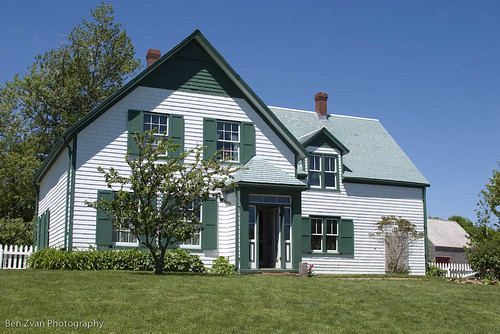
Potted Geranium was created three years ago. The subject matter for this painting is indirectly related with my previous posting- Raspberry Cordial with Anne Shirley, so I was tempted to add it to this blog. The setting is from one of the upstairs bedrooms in the Green Gable House in Cavendish. I was fascinated by how the diffused light worked it's way through the petals of the blooms and on the dark wood surface. Luckily, I had brought my camera along during our visit.

I took a bit of artistic licence to change a few things within the composition. Part of the sewing machine is from the Green Gable House and the central part that would include the Singer logo was from a sewing machine that once belonged to my grandmother (b. 1889). The geranium was originally in a large can that had been covered with some Mac-tac that boasted a printed ivy motif. I opted to use a empty Campbell's Soup can - New England Clam Chowder to give a bit of contemporary realist twist, that also made reference to one of my favorite Pop Art artist, Andy Warhol.