Showing posts with label cambell soup can. Show all posts

Sunday, October 11, 2026

La Dune de Bouctouche, un hommage à Antonine Maillet

       12 x 12", acrylic on cradle aluminium panel
painting #301, 2025-26 / black wooden floater frame

ENGLISH TO FOLLOW

Il s'agit d'une œuvre jumelle de la précédente, rendant hommage à l'auteure Antonine Maillet. L'emplacement de cette peinture est la dune de Bouctouche, plus précisément l'Éco-centre Irving et sa promenade à Saint-Édouard, au Nouveau-Brunswick.

Les deux livres figurant dans cette composition sont ses deux premiers romans. "Pointe-aux-Coques", publié en 1958, lui a valu le prix Champlain, suivi de "On a mangé la dune" en 1962. Ce second ouvrage marque une rupture stylistique majeure : Antonine Maillet commence à s'éloigner du français classique pour laisser la jeune protagoniste du roman s'exprimer avec ses propres mots. Cette démarche a ouvert la voie à l'usage du parler acadien qui allait plus tard assurer à l'auteure une renommée internationale. Ces deux romans sont semi-autobiographiques ; le village fictif de Pointe-aux-Coques s'inspire de Richibouctou-Village et du Cap-de-Richibouctou (Cap-Lumière).

Peu après avoir obtenu un baccalauréat es arts , elle a rejoint la congrégation des Sœurs de Notre-Dame-du-Sacré-Cœur en 1950, à l'âge de 21 ans. Elle a fait partie de cette communauté religieuse de 1950 à 1967. Au début de sa carrière, tout comme ses parents, elle a exercé le métier d'enseignante. Son premier poste d'enseignante se situait à Cap-Lumière, vers 1950. Selon mon défunt père, l'école se trouvait à environ 400 mètres de la maison où j'ai grandi. Ma marraine, alors nommée Rachelle Cormier, a enseigné à ses côtés durant cette période. Cormier était également le nom de jeune fille de la mère d'Antonine Maillet, laquelle est la narratrice de son premier ouvrage.

Ces livres existent bel et bien individuellement, mais sont réunis en un seul volume pour cet édition. Bien que son éditeur canadien soit Leméac (Montréal), cet ouvrage a été publié en 1977 par Marabout, en Belgique. Je l'ai commandé en ligne auprès d'un libraire français spécialisé dans les livres usagés. Toujours à l'aide de Photoshop et de quelques astuces de numérisation, j'ai créé deux nouveaux dos de livre et ensuite recouvert un second bouquin de même format pour réaliser "On a mangé la dune".

Bien entendu, les fleurs lui sont destinées. Quant à la boîte de soupe Campbell's, je tenais à y ajouter une touche d'humour et une référence à la cuisine acadienne. La boîte de soupe Campbell's est évidemment un clin d'œil à Andy Warhol. Situé à Camden, dans le New Jersey, le siège social de Campbell's se trouve juste de l'autre côté du fleuve Delaware, à seulement 4 km (2,5 miles) de Philadelphie. Si le périple d'Évangéline, l'héroïne de Longfellow, s'achevait à Philadelphie, Pélagie — personnage du roman "Pélagie-la-Charrette" d'Antonine Maillet — y arrive en 1776, au chapitre 12. C'est là qu'elle rencontre Beausoleil Broussard, avec qui je partage un ancêtre commun : Michel Sansoucy Richard, venu de France entre 1651 et 1654.

Antonine Maillet s'est éteinte le 17 février 2025, alors que je travaillais sur cette peinture. Par un curieux hasard, ce matin-là, en descendant l'escalier, j'ai entendu mon épouse Suzanne — qui regardait la chaîne Radio-Canada ICI Télé — annoncer la nouvelle de son décès. En tournant les yeux vers l'écran, j'ai vu une image figée de l'écrivaine marchant sur la même promenade en bois que celle figurant dans mon tableau. Bien qu'elle ait passé la majeure partie de sa vie d'adulte à Montréal, elle possédait un magnifique chalet en forme de phare, située à quelques kilomètres seulement de cette promenade.


Elle était la tante de Cécile Maillet, l'une de nos amies les plus proches, également infirmière. Je me souviens avoir brièvement rencontré Antonine Maillet au début des années 1980, chez ses parents. Je dois beaucoup à Cécile. À l'automne 1986, c'est elle qui m'a convaincue de suivre, à ses côtés, un cours de dessin de perspective de dix semaines enseigné par Sylvain Arseneau. La dernière séance était consacrée à une initiation à la peinture acrylique. Quelques mois plus tard, je réalisais ma première toile en toute autonomie. Elle a également joué un rôle majeur dans mon éveil spirituel. Malheureusement, alors qu'elle s'apprêtait à prendre sa retraite comme d'infirmière, elle a été percutée par l'arrière par un camping-car lors d'une sortie à vélo et a subi un traumatisme crânien majeur. Elle est décédée l'an dernier, à l'âge de 69 ans, après avoir passé plusieurs années en établissement de soins de longue durée.

Antonine Maillet et sa nièce Cécile partagaient le même type d’idéalisme : elles étaient des femmes indépendantes, anticonformistes — des esprits libres.


Cécile Maillet


L'un des aspects de la peinture que je trouve particulièrement difficile est la représentation d'éléments flous. Lorsque j'ai réalisé l'étude photographique sur place pour ce tableau avec mon Google Pixel 7, seuls les livres et les fleurs étaient parfaitement en focus; j'avais omis de photographier la structure elle-même, notamment les rampes et les planches de la passerelle. J'ai eu beaucoup de mal avec la zone située immédiatement à gauche, derrière les livres. La semaine dernière, j'ai décidé de retirer le vernis de cette partie à l'aide d'essence de térébenthine distillée pour retenter ma chance afin de créer une image plus harmonieuse. C'est là que mes compétences en dessin de perspective m'ont bien servi : j'ai en effet réinventé cette section en y intégrant une rampe totalement différente.

Ces deux tableaux rendant hommage à Antonine Maillet ont été conçus à l'origine comme soumission au programme d'acquisition pour la Banque d'œuvres d'art du Nouveau-Brunswick (2026). Malheureusement, ils n'ont pas été retenus par le jury. Cette exposition leurs donne une fenêtre de voir le grand jour. 


---------------------------------


A postage stamp of Antonine Maillet was issued by Canada Post on November 27, 2024. One has been affixed on the back of each frame. 
-------------
Un timbre à l’effigie d’Antonine Maillet a été émis par Postes Canada le 27 novembre 2024. L’un d’eux a été apposé au dos des deux cadres.


----------------------------------


This is a sister painting of the previous, paying homage to author Antonine Maillet. The setting for this work is at the Bouctouche Dune, more precisely, the Irving Eco-Centre and Boardwalk in St-Edouard, NB. 

The two books for this composition were her first two novels. "Pointe-aux-Coques" published in 1958 earned her the Prix Champlain followed by "On a mangé la dune" in 1962.  The second work marks a crucial stylistic break. Antonine Maillet begins to detach herself from classical French, allowing the young protagonist of the novel to express herself in her own words. This paved the way for the use of the Acadian dialect that would later bring the author international renown. These two novels are semi-autobiographical. The fictional village of Pointe-aux-Coques is based on Richibouctou-Village and Cap-de-Richibouctou (Cap-Lumière). 

Right after earning her bachelor's degree. Maillet joined the congregation of the Sisters of Notre-Dame-du-Sacré-Cœur in 1950 at the age of 21. Her time in the religious community spanned from 1950-1967. Early in her career, like her parents, she started out as a teacher. Her first teaching job was in Cap-Lumière around 1950. According to my late father, that schoolhouse would have been located 400m from the house I grew up in. My godmother, then Rachelle Cormier thought with her during this period. Cormier was also Maillet's own mother's family name who is the narrator of her first offering.

These specific books do exist individually, but in one single volume for this edition. While her Canadian publisher is Leméac in Montréal, this book was published by Marabout in 1977 out of Belgium. I ordered it on-line from a French used book retailer. Again, with the help of Photoshop and some scanning tricks, I created two new spines and wrapped a second book of the same size to create "On a mangé la dune". 

Of course, the flowers are for her. As for the Campbell's soup can, I had to add some humour and Acadian cuisine in the mix. In English, these titles translate to "Clam Point" (Pointe-aux-Coques) and "We Ate the Dune" (On a mangé la dune), while "Clam Chowder" is the translation for Chaudrée aux coques. Of course, the Campbell's Soup can is a wink to Andy Warhol. Located in Camden, New Jersey, the Campbell's headquarters sits just across the Delaware River - only 4 km (2.5 miles) from Philadelphia.  While Longfellow's Evangeline's peril ended in Philadelphia, Pélagie in Maillet's "Pélagie-la-Charette", arrives in Philadelphia in 1776 at chapter 12. Here, she meets Beausoleil Broussard with whom I share the same ancestor- Michel Sansoucy Richard who immigrated from France circa 1651-1654.  

Antonine Maillet died on February 17, 2025 while I was working on this painting. Ironically, coming down the stairs that morning, my wife Suzanne was watching Radio-Canada ICI Télé and announced her passing. As I looked at the TV, the image on the screen on pause was her walking on the same boardwalk as in my painting. While she had lived most of her adult life in Montreal, she owned a beautiful cottage in the shape of a lighthouse only a few kilometers from the boardwalk.


She was the aunt of one of our closest friend and fellow nurse Cécile Maillet. I remember meeting Antonine Maillet briefly during the early 1980's at her parent's house. I owe a lot to Cécile. During the fall of 1986, it was her who coaxed me to join her in taking a perspective drawing course over a 10 week period with Sylvain Arseneau. The last session was an introduction to acrylic painting. A few months later, I would complete a first painting on my own. She also played a great role in my spiritual awakening. Sadly, pending her retirement from nursing, she was hit from behind by a motorhome while on a bike ride and suffered a major brain trauma. She also passed away last year at the age of 69, after spending several years in a nursing home. 

Antonine Maillet and her niece Cécile shared the same kind of idealism: they were independent, nonconformist women—free spirits.

One aspect of painting that I find particularly difficult is painting anything that is out of focus. When I did the photo study on site for this painting with my Google Pixel 7, only the books and flowers were in full focus. I omitted to take pictures of the structure itself, railings and deck board. I truly struggled with the immediate left section behind the books. This past week, I decided to remove the varnish on that section of the boardwalk with distilled turpentine and give it another go in order to create an image that was more harmonious. This is when my perspective drawing skills served me well. I did re-invent that section with an all-together different railing.

These two paintings paying homage to Antonine Maillet were initially conceived as a submission to the 2026 New Brunswick Art Bank acquisition program. Unfortunately, they were not retained by the jury, but this exhibition still gives them a window to see the light of day.

This painting will part of my two-person show with Jon Wilkinson entitled- 
''Still Lives, Silent Places'' 
held at the Fog Forest Gallery 
from October 16 - November 6, 2026.
Gallery hours - Thursdays and Fridays from 10 am to 5 pm or by appointment. 

To acquire this painting, please contact the gallery. 
Fog Forest Gallery
14 Bridge Street
Sackville, NB, Canada
(506) 536-9000
website- http:/fogforestgallery.ca

Tuesday, December 6, 2022

Paintings for Sale, an homage to Maud Lewis


Acrylic on mounted gessoed aluminium panel, 14 x 11"
Painting #293, 2022

When I first visited the Art Gallery of Nova Scotia (AGNS) located in Halifax back in the late 1980's, I distinctly remember a display of folk art that was part of the museum's permanent collection on one of the upper floors. Among the painters that stood out to me at the time were Joseph Norris (1925-1996) and Maud Lewis (1903-1970). I became aware that this institution held folk art to the same standards as the more academic art movements.  


Maud Lewis in her painted house, photo Bob Brooks
                               
Much has already been written about Maud Dowley Lewis. With the passage of time and sustained public interest, her popularity has only continued to grow. In recent years, she has been elevated to the status of an icon. It's impossible to separate the artist from the life she lead and the artwork she created. While her story is defined by poverty, hardship, physical disabilities and debilitating rheumatoid arthritis, it was also one of triumph over adversity that was sparked by her creativity and her temperament to endure.

Her paintings are a celebration of life and the beauty she observed in her own little world located in Digby and Yarmouth counties Nova Scotia. Unlike her own life, her paintings are happy, whimsical and colorful. Subject matter often remain within the domain of birds, flowers, oxen, cats, deer, modes of transportations (pulled sleigh or wagons, cars, trucks, boats), bucolic winter, pastoral and costal scenes. These themes and imagery were revisited time and again. 


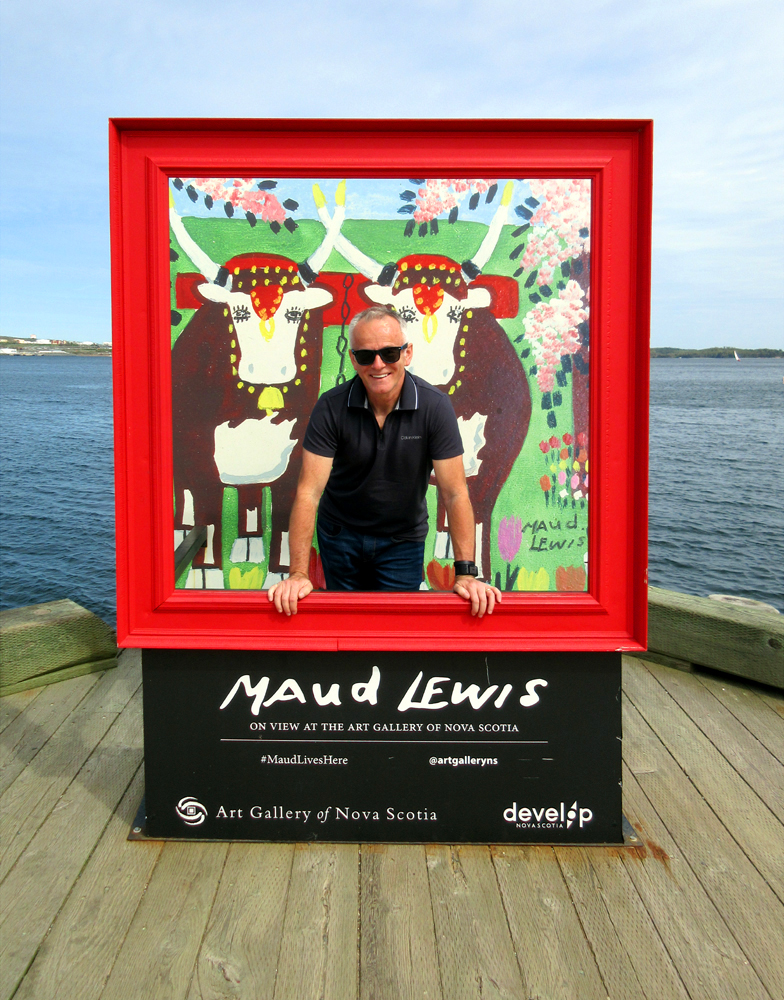
Photo op on the Halifax Waterfront - May 2022

While growing up, Maud Lewis was introduced to art and painting by her mother. She crafted hand made Christmas cards done in pen and ink, watercolors and crayola crayons and sold them door to door. After the death of her father in 1935, then later her mother in 1937 she moved out of the family's South Ohio home. There is a brief transition period where she lived with her brother Charles then with her aunt Ida in Digby. Her acquaintance with Everett Lewis was a result of answering an ad when he was looking to hire a housekeeper. They married in 1938 of what appeared to be a mariage of convenience. Her painting career gradually evolved over the 30 years that followed. Her signature painting style was not restricted to panels and boards but could also be found on rock, scallop shells and household items. With her reputation growing over time, the little painted house in Marshalltown would become a popular roadside attraction for locals, visitors and tourists alike with many becoming patrons and collectors of her paintings. 

Her work began garnering unsolicited attention by the media during the 1960's. During the Richard Nixon administration either as US president or vice president (conflicting reports), he would have commissioned two paintings. NS premier Robert Stanfield also started to collect her work. In 1965, writer Murray Bernard and photographer Bob Brooks of the Star Weekly Magazine published by the Toronto Star were dispatched to Marshalltown to do a story on Maud. This nation wide publicity would increase demands for her paintings and elevate her status as a painter. The photography taken by Brooks remains the quintessential pictures taken of her as an artist. On November 25, 1965, CBC's biography series Telescope aired a 30 minute televised documentary on the Lewis couple. (A portion of this documentary can be viewed on this CBC LINK . )

Much has also been written about the relationship with her husband, Everett Lewis. In his case, not always in the best light. With the thousands of paintings sold, he could have provided a much better life for her. Her paintings sold for about $2 to 3 dollars at first with gradual price increase to 5 dollars and 7 to 10 dollars for larger paintings. With inflation, a 5 dollar painting would be have been worth the equivalent of about $47 in 2022. While their house was very small, they also lived without indoor plumbing, running water or electricity. 

Everett Lewis (b.1893) was raised in the Alms House in Marshalltown, NS. after his father abandoned the family while he was still a child. It was an institution known locally as the "Poor Farm". He had no formal education, he never learned to read or write. He earned a living as a fish peddler and also worked at Alms House as a night watchman then later as caretaker. The parcel of land that Everett bought for his house was an adjacent lot to the Alms House. In the 1965 CBC documentary, we can see Everett leaving the house on his bicycle and passing in front of the Alms House about 200 meters away.  Despite living in poverty, Everett had a reputation of being a miser and had accumulated considerable wealth by the time of his unfortunate and untimely death in 1979. Everett himself dabbled in folk art creating paintings that were very much inspired by Maud. The Art Gallery of Nova Scotia would acquire some of his work while he was still living. 

In 1961, Ten-Mile House and Art Gallery in Bedford, NS owned by Bill Ferguson And Claire Stenning started selling her paintings doubling the purchase price to 10 dollars since these were framed. Maud and Everett Lewis didn't want to appear greedy by increasing the price of the paintings in fear of losing customers and alienating an already established market. 


My wife Suzanne with the Painted House, AGNS - May 2022


Interior of the Maud Lewis House, AGNS, Halifax, NS

Part of Maud's legacy is the little painted house they lived in with many surfaces and items used as her canvas. From the window, walls, doors, stairs to dustpan, cooking stove and breadbox. Their house would become her greatest work. After Maud's passing, Everett did little to nothing in upkeeping the house. In 1979, The Painted House Society was formed in Digby following Everett's death. The house, land and copyrights were purchased by the society from Everett's heir the following year. Unable to raise the $50,000 needed to restore the house, the estate was sold to the Province of Nova Scotia in 1984. The house was moved to a secure indoor location outside Halifax in order to prevent further decay. It would take another decade before restoration would be undertaken and to plan for it's permanent home once the restauration completed. The Scotiabank Maud Lewis Gallery which also included the house opened to the public in 1998 part of the expansion of the AGNS.

Since her death, the AGNS has been a major catalyst in preserving her legacy, with the restauration of the house and amassing a collection of her paintings that is on permanent public display. 

Author Lance Woolaver would become Maud Lewis' premier biographer. He's written several books including the popular picture book, The Illuminated Life of Maud Lewis with photography by Bob Brooks (1996). A retrospective exhibition of Maud's work sharing the same title was organized by the Art Gallery of Nova Scotia in 1997 that would later tour Canada. A full length documentary also named, The Illuminated Life of Maud Lewis was produced by the National Film Board in 1998 with the script provided by Woolaver. He has also written two plays about Maud, A World Without Shadows (1996) and The Return of her Child. And is the writer of her full biography, The Heart at the Door (2016). 

In 2019, the McMichael Canadian Art Collection (MCAC) in Kleinburg, Ontario organized the touring exhibition: MAUD LEWIS. The exhibition in currently on view at the Art Gallery of Nova Scotia until April 23, 2023. An art book entitled "Paintings for Sale" by Sarah Milroy, chief curator of the MCAC was published in conjunction with the exhibition. The book cover is an image of "PAINTINGS FOR SALE", the road sign that she painted and used outside her home. This book also served as the base and title for my painting.

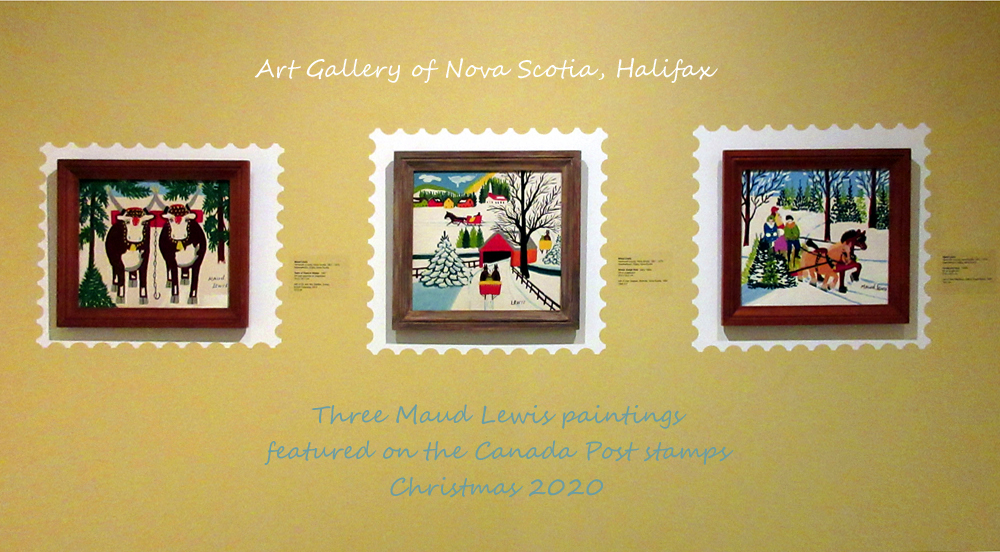
On November 2, 2020, in time for the Holidays, Canada Post issued three stamps featuring her winter themed paintings from the Art Gallery of Nova Scotia collection. All of the Christmas cards we mailed that year were adorned by these stamps.


In 2017, Mongrel Media and Sony Pictures Classic released Maudie. An award winning feature film of the life of Maud and Everett Lewis starring Sally Hawkins and Ethan Hawke. The movie was directed by Aisling Walsh. This film introduced Maud Lewis a much wider audience outside Canada. Receiving generally positive reviews with an approval rating of 89% on Rotten Tomatoes based on 151 reviews. Sally Hawkins gives an arresting performance as Maude. It won awards in all of the seven categories it was nominated for at the 2018 Canadian Screen Awards, including trophies for best actress, supporting actor, director, screenplay and best film. The film stimulated a resurgence and an interest in Lewis' work. It is currently available for streaming on Netflix.  

Maud Lewis was never really allowed to spend the money she made in order to make her life more comfortable. On the other hand, collectors of her work have been raking in the rewards for having a keen eye for art at a bargain. I remember seeing a few of her paintings being resold in commercial galleries in Halifax for about $4000 to $5000 during the 1990's. On November 30, 2009, her painting "A Family Outing" sold for $22,000 CND at a Bonham's Auction in Toronto. A painting found in 2016 at an Ontario thrift store, "Portrait of Eddie Barnes and Ed Murphy, Lobster Fishermen" was sold in an online auction for $45,000 CND. Click HERE. In May of this year, a painting entitled "Black Truck" made national headlines as it was traded during the 1970's to restauranteurs in exchange of a grilled cheese sandwich by a Maud Lewis art collector, an Ontario artist named John Kinnear. The story goes that Kinnear and his wife had lunch at the restaurant every day. And every time he ordered the same grilled cheese sandwich. Kinnear also kept in touch with Maud Lewis, sending her proper art supplies and boards. The painting was expecting to fetch as much as $35,000 CND at auction. But when the hammer fell, it went for 10X as much, for $350,000 CND. Full story HERE and follow-up HERE.

I've always been an admirer of Maud Lewis' artwork but doing an homage painting only appeared on my radar as a result of the pandemic. While we were restricted to the Atlantic bubble for travels because of the Covid-19, my wife and I did a few road trips within the maritimes provinces. In mid-September 2020 we visited the western portion of Nova Scotia. Our itinerary took us to various sites that had a direct connection with Maud Lewis. The background painting that appears in my own painting was the featured image for the month of August in the Maud Lewis 2021 calendar. Growing up in Cap-Lumière, NB, I could relate with the image since our house was located one mile from a similar looking lighthouse. In the calendar, it is referred to as "Lighthouse and Steamer", while in the art book Paintings For Sale by Sarah Milroy, as Untitled (Digby Ferry Passing Point Prim Lighthouse), 1950's. This lighthouse was located 14 km from the Lewis' house. 


The current Point Prim Lighthouse built in 1964 


The original Point Prim Lighthouse dates back to 1817. It was destroyed
by fire in 1873. The lighthouse that appears in the Maud Lewis painting
replaced the original. It was equipped with an attached lighthouse keeper's
residence. It remained in operation until 1964 when it was demolished and
replaced by the current lighthouse. 


When the province of Nova Scotia acquired the Painted House in 
1984, it also purchased its' land in Marshalltown. In 1997, a 
stainless steel framed structure was erected where the house once stood
and a memorial park was established on the remaining grounds.


This Painted House Replica was built by Ross Murray in 1999 on his 
property. Located on Route 217, seven km from where the original house once stood.
Amazing to see so much attention to details. The property also
included a shed and a mailbox. Being there and able to enter the house
and walk around the grounds was like entering a movie set. Completely surreal! 
Click HERE for backstory. 


Photo op in Yarmouth, NS - Birthplace of Maud Lewis - September 2020

My decision to use a Campbell's Soup can as the centerpiece was inspired by the Bob Brooks photo. She used the can to wash her brushes with turpentine. The one shown in the picture taken in 1965 would have been of the same period as when Andy Warhol did his 32 Campbell's Soup Cans in 1962. 

During the summer of 2020, we visited the Village Historique Acadien in Bertrand, NB. Among its' buildings is a replica of the original Nicholas D. Thériault General Store (1924). Almost every items inside are for sale for a few exceptions. The available inventory is meticulously curated by Mrs Lanteigne. While none are antiques, every items has a vintage flair. The top shelf had a display of can goods wrapped in vintage replica labels. When I spotted the vintage Campbell's Tomato Soup cans, my knees buckled. The label is probably pre 1930. When she told me that they weren't for sale, I was so disappointed but understood the situation. When we returned in 2021, I had forgotten about them, but upon seeing them again, my desire to acquire one was renewed. Fortunate for me, she remembered me and said she felt bad once I had exited the door. I had mentioned that I was a painter and wanted to incorporated one somehow in a painting. She kindly agreed to give me one, as long as I was willing to climb up the step ladder to get it. It was a fun moment and I was very thankful. 

I could have used a very similar soup can as in the photo of Maud Lewis, but opted for the retro can to create a narrative that linked her earlier years while her mother taught her how to draw, paint and play the piano when she lived in South Ohio, located 11 km north of Yarmouth.   


If you are still reading, hoping you enjoyed the ride!


This painting is currently on view in a group show entitled "Comfort and Joy" at the Fog Forest Gallery

-SOLD

Wednesday, October 23, 2019

Hibiscus in a Campbell's Soup Can, an homage to Andy Warhol


16 x 12", acrylic on mounted gessoed aluminium panel
painting #274, 2019

I first became aware of Andy Warhol's ''Flowers'' serigraph prints during the late 1980's when one of the many variations was featured predominately on the set of the CBS sitcom, Murphy Brown, starring Candice Bergan. 

After acquiring this Andy Warhol art book from the Taschen's Basic Art Series 2.0, I became curious about the backstory behind the image. Warhol would draw inspiration from a photograph of hibiscus flowers by Patricia Caulfield that appeared in a 1964 issue of Modern Photography. He was later sued in 1966 for the first time by the photographer for copyright infringement. Warhol was a very prolific artist. With the help of a few workers inside of "The Factory" (his studio), in one day, he could produce as many as 80 of these flowers silkscreens, printed in various sizes.  

L- photography of hibiscus by Patricia Caulfield
R- serigraph print of "Flowers" by Andy Warhol

For at least the past decade or so, we've been buying a hibiscus plant every spring for the veranda in front of our house. For the most part, the blooms only last one day or two, but it has several blooming cycles during the summer. This spring while stepping into our local Home Depot, they had a variety of dwarf hibiscus that is more of a potted flower than a potted plant. By the time I got back home, the concept for this painting came to me. I then acquired a Campbell's soup can on eBay from a US listing since here in Canada, the label was modernized more than a decade ago. I had initially intended to just do black background. Once it was done, the idea of using a modified version of Marilyn Monroe from Warhol's reversal series was introduced. I repeated the image as if it was wallpaper like Warhol did with Cows in 1966. 

This past July, after my wife Suzanne gave me the green light, I headed for Europe for three weeks to do some backpacking with our son Jean-Luc. This was his graduation gift for completing a bachelor's degree in business administration at the Université de Moncton. At the very beginning of the trip, we spent three days in Barcelona, Spain. As luck would have it, we were fortunate enough to view a serigraph print exhibition of Andy Warhol. The whole collection was owned by one individual, and was comprised mostly of many variations of Marilyn Monroe, Campbell's Soup Cans, Flowers and Mao Tse Tung. Click HERE for link. 


Painting to be shown this weekend at Art Toronto with Galerie de Bellefeuille (Booth A12)
Opening Night Gala: Thursday, October 24, 2019: 6:30 PM – 10:00 PM
Fair Hours: Friday, October 25, 2019: 12AM – 8:00PM
Saturday, October 26, 2019: 11:00AM – 8:00PM
Sunday, October 27, 2019: 11:00AM – 6:00PM
Location
Metro Toronto Convention Centre, North Building
255 Front Street West, Toronto
-SOLD

Wednesday, October 11, 2017

Vine Tomato on Warhol Campbell Soup Can / Green Tomato on Warhol Campbell Soup Can

Each- 8 x 5", acrylic on gessoed hardboard
paintings # 252 & 251, 2017

Five years ago in 2012, the Campbell Soup Company would issue a limited edition of four Andy Warhol inspired labels for their Tomato Soup to commemorate the 50th anniversary of Warhol's first important solo exhibition that comprised of the 32 varieties Campbell Soup was offering at the time. The show was held at the Ferus Gallery in Los Angeles in 1962. The collection would eventually be acquired by the Museum of Modern Art in NYC in 1996 by bequest/gift/purchase.


 MOMA, visit Nov. 2010


The Warhol edition of 1,2 million cans of Campbell's condensed tomato soup were sold at Target Store in the USA for 75 cents each. A former co-worker was vacationing in Maine at the time and was able to get me a full set of 4. It was the third time that Campbell Soup would honour the Pop Art icon with these signature cans; the first being in 2003 for the Eagles Grocery Stores chain (Pittsburgh) and at Barney's during the Holiday season of 2006. 

The Campbell Soup Company did approve of Warhol Soup Can Art since it provided them with some unsolicited free publicity as this letter can attest. In 1993, the company would buy a Warhol painting of one of his tomato soup cans to hang in the boardroom of there headquarters. 


During the promotion and sale of these special edition cans, the Campbell's Facebook page was offering 15 minutes of fame to their followers. I was the 100th to enjoy my Art of Soup moment!


Part of my two-person show with Yvon Gallant entitled ''HARVEST'' at the Fog Forest Gallery from October 12 - November 8, 2017.

Opening reception - Thursday October 12, 6:30- 8:00 pm

Fog Forest Gallery
14 Bridge Street
Sackville, NB, Canada
(506) 536-9000
Website- http://fogforestgallery.ca

-SOLD / -SOLD

Friday, October 16, 2009

Marbles on ''Three Coke Bottles''

Acrylic on gessoed hardboard, #176
5 x 7', 2009

Three Coke Bottles is an acrylic and silkscreen done by Andy Warhol in 1962. Here it appears as a blank card format on a semi out of focus Campbell's Soup Can 1 (1968), from the book Pop Art by Tilman Osterwold.

I leave you with famous quotes by Andy Warhol:

-''I am a deeply superficial person''.

-''Everybody must have a fantasy''.

-''Art is what you can get away with''.

-''Think rich, look poor''.

-''TV is not something to watch, but something to be on''.

-''Employees make the best dates. You don't have to pick them up and they're always tax- deductible''.

and of course,

-''In the future, everybody will be world famous for 15 minutes''.

This is the final piece for my solo show, Near & Far that opens this evening at Handworks Gallery in Saint John, NB. Everyone is invited to the Opening reception that will take place this evening from 5 to 8 pm and will coincide with a Gallery Hop with the other 10 art galleries/institutions of the city.

Part of my solo show- Near & Far - October 16-30, 2009.
-SOLD

Wednesday, October 14, 2009

Tomate sur TOMATES

Acrylic on gessoed hardboard, #1747 x 5'' - 2009

The next three paintings are all inspired by Andy Warhol. Warhol's first solo exhibition took place at the Ferus Gallery, Los Angeles, during the summer of 1962. The show comprised of 32 paintings of all the varieties of Campbell's Soup cans sold by the company at the time. When asked why he painted them, he replied that he had eaten Campbell's soup for lunch for the last 20 years. On May 9, 2006, Small Torn Campbell's Soup Can (Pepper Pot) - 20 x 16'', 1962 was sold at a Christie's auction to Gagosian Gallery for a whopping $11 776 000 (incl. buyers premiums)- click here.

Last week, as I was doing the grocery shopping, I notice a display case in the store that boosted more than 60 varieties of Campbell Soup Cans.

Campbell's Soups have been around since 1869, and the famous font lettering on red with the gold seal from the 1900 Paris Exhibition as been around for more than a century. Classic design are all in fashion. In 1968, Campbell's introduced the mail-in offer of the groovy Souper Dress , which could be bought for $1 and two labels.
_
Part of my solo show- Near & Far - October 16-30, 2009.
-SOLD

Thursday, July 31, 2008

Potted Geranium


Acrylic on gessoed hardboard,
14 x 18'', 2005, # 90
private collection - Boston, Ma.

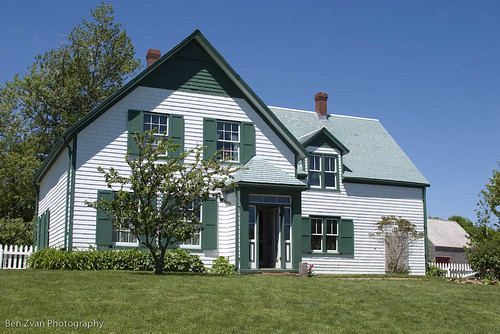
Potted Geranium was created three years ago. The subject matter for this painting is indirectly related with my previous posting- Raspberry Cordial with Anne Shirley, so I was tempted to add it to this blog. The setting is from one of the upstairs bedrooms in the Green Gable House in Cavendish. I was fascinated by how the diffused light worked it's way through the petals of the blooms and on the dark wood surface. Luckily, I had brought my camera along during our visit.

I took a bit of artistic licence to change a few things within the composition. Part of the sewing machine is from the Green Gable House and the central part that would include the Singer logo was from a sewing machine that once belonged to my grandmother (b. 1889). The geranium was originally in a large can that had been covered with some Mac-tac that boasted a printed ivy motif. I opted to use a empty Campbell's Soup can - New England Clam Chowder to give a bit of contemporary realist twist, that also made reference to one of my favorite Pop Art artist, Andy Warhol.