Showing posts with label flower. Show all posts

Sunday, September 28, 2025

Racines Acadiennes


16 x 12", acrylic on mounted gessoed aluminium panel
painting #303, 2025

These two local history books belongs to the clients who commissioned this painting. Both grew up in Acadian villages, but in different provinces. This painting is an homage honoring their ancestors and Acadian roots. 

Father Anselme Chiasson, the author of Chéticamp, histoire et traditions acadiennes (1961) is also the co-author of Sainte-Anne-de-Kent (1886-1986) which was co-written by Arthur Poirier, father of one of the clients.

Father Anselme Chiasson (1911-2004) was an Acadian Catholic priest, historian, ethnographer, and folklorist. He was a staunch defender of Acadia, both for it's language and culture. His name is associated with the founding not only of the Université de Moncton, but especially of the Centre d'études acadiennes (Center for Acadian Studies) which, under his leadership, became a reference on Acadian history, culture, and genealogy. While representing the Church and preaching the faith throughout his life, he denounced injustices toward the Acadian community.

He played a prominent role in promoting historical research. In 1960, he co-founded the Acadian Historical Society in New Brunswick with Father Clément Cormier and journalist Émery Leblanc. He also served as an archivist. In 1961, he founded Les Éditions des Aboiteaux, the first publishing house in Acadia, of which the book of Chéticamp pictured above was published that same year. He himself is the author of some fifteen books.

On the occasion of his 70th birthday, author Antonine Maillet wrote: "Of all the Acadians I know, Father Anselme Chiasson is the most Acadian." Father Chiasson was named an officer to the Order of Canada  along the designations of Chevalier to several French orders.  

While these books carry significant importance to their owners, the Sainte-Anne-de-Kent book is especially significant to me personally. Upon graduating from Nursing School, I would spent the next five years working in a rural hospital located in this community. It is here that I would meet my future wife and where I did my first painting. The artwork on the book cover is by the artist René Hébert. Hébert was born in Moncton in 1932. He studied fine arts at the École des beaux-arts de Montréal. He initially worked as a graphic artist in Toronto before moving to Sainte-Anne-de-Kent along the Northumberland Strait where he would set up his art studio and raised his family with his wife. He paints with an economy of brush strokes using bold and expressive colors exploring rural life and the landscape of Eastern Canada. He was a friend of the Quebec artist Tex Lecor. It's evident that they were influenced by the artists of the Group of Seven. I visited his studio during the mid 1990's and acquired one of his iconic paintings.

Prior to the publishing of this book, the wooded Roman Catholic Church in Sainte-Anne-de-Kent depicted on the cover had received the designation of Provincial Historic Site. The interior featured 48 iconographic frescos and paintings by local artist Édouard Gautreau, a Murano glass chandelier and sculptures by its' architect Léon Léger. I remember attending mass here and zoning out of what the priest was saying as my head was always going around in circles looking at the artwork. That church was often referred to as the Acadian Sistine Chapel. Sadly, on June 29, 2005, the church was hit by lightning and quickly burned to the ground. Only a few removeable pieces of artwork were saved. Growing up in Cap-Lumière, I was an alter boy while attending church in Richibouctou-Village. A massive painting of Saint Antony of Padua also painted by Edouard Gautreau hung above the alter. It's certainly the first great work of art that I saw as a child and have probably spend hundreds of hours admiring it. Sainte-Anne-de-Kent is also where my own mother was born and grew up. 

As retirement was looming for the couple who commissioned this painting, they decided to leave big city life, change province and built their dream home on rural ancestral land. This painting is to grace their new house. I proposed using my Preserve mason jar for the peonies, her favorite flower. The original purpose of these canning jar is to preserve food. Symbolically, I often use them as a vehicle for preserving memories. The composition rests on is a Danish/Scandinavian inspired mid-century modern side table. This piece of furniture had sentimental value to her since it brought flair and style to her former workplace. I was pretty much given full artistic license as they wanted the artwork to be painted in my signature style. I chose an outdoor setting as I wanted the peonies to bask in natural light. 

During the late 1980's, I became a fan of the Canadian alternative rock band Chalk Circle. In 1987, they released an album entitled, Mending Wall. The inspiration for the title was borrowed from a Robert Frost poem of the same name. Good fences makes good neighbors, a line from that poem also appeared in the lyrics of their song N.I.M.B.Y. (not in my backyard). Since then, every time I see a fence, the Robert Frost reference always comes to mind. With that said, I've opted for a fence in the background as I've done in several previous painting.


Mending Wall, a poem by Robert Frost 


N.I.M.B.Y  (not in my backyard) - by Chalk Circle
Music video filmed in Dartmouth and Peggy's Cove, NS.


-Private Collection

Tuesday, December 6, 2022

Paintings for Sale, an homage to Maud Lewis


Acrylic on mounted gessoed aluminium panel, 14 x 11"
Painting #293, 2022

When I first visited the Art Gallery of Nova Scotia (AGNS) located in Halifax back in the late 1980's, I distinctly remember a display of folk art that was part of the museum's permanent collection on one of the upper floors. Among the painters that stood out to me at the time were Joseph Norris (1925-1996) and Maud Lewis (1903-1970). I became aware that this institution held folk art to the same standards as the more academic art movements.  


Maud Lewis in her painted house, photo Bob Brooks
                               
Much has already been written about Maud Dowley Lewis. With the passage of time and sustained public interest, her popularity has only continued to grow. In recent years, she has been elevated to the status of an icon. It's impossible to separate the artist from the life she lead and the artwork she created. While her story is defined by poverty, hardship, physical disabilities and debilitating rheumatoid arthritis, it was also one of triumph over adversity that was sparked by her creativity and her temperament to endure.

Her paintings are a celebration of life and the beauty she observed in her own little world located in Digby and Yarmouth counties Nova Scotia. Unlike her own life, her paintings are happy, whimsical and colorful. Subject matter often remain within the domain of birds, flowers, oxen, cats, deer, modes of transportations (pulled sleigh or wagons, cars, trucks, boats), bucolic winter, pastoral and costal scenes. These themes and imagery were revisited time and again. 


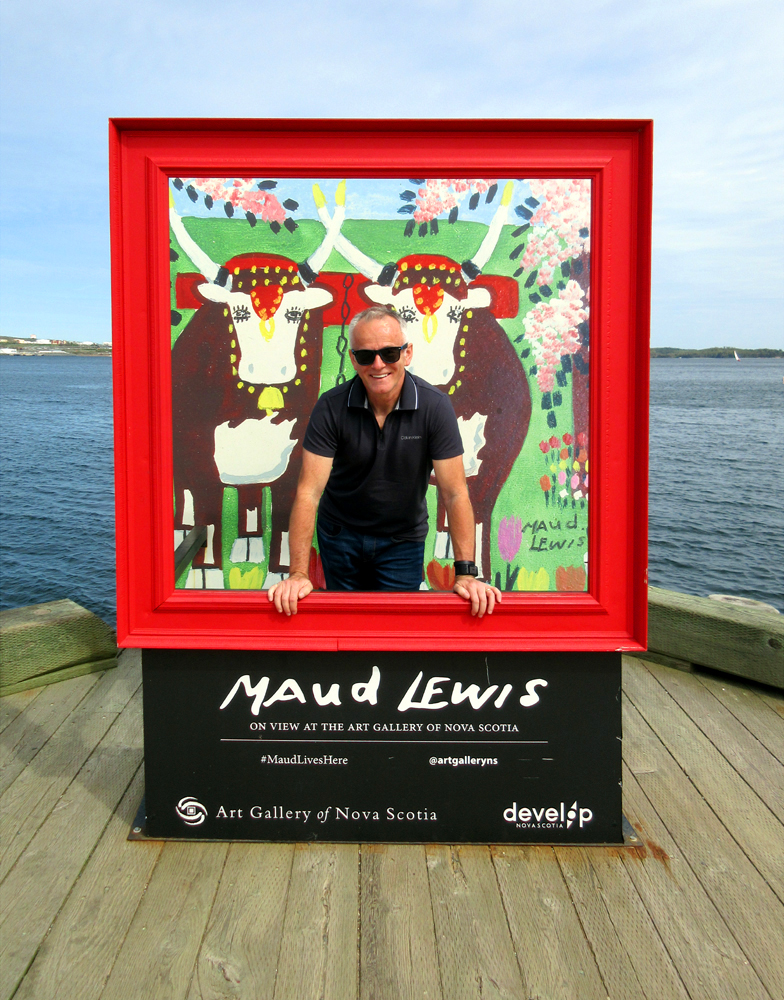
Photo op on the Halifax Waterfront - May 2022

While growing up, Maud Lewis was introduced to art and painting by her mother. She crafted hand made Christmas cards done in pen and ink, watercolors and crayola crayons and sold them door to door. After the death of her father in 1935, then later her mother in 1937 she moved out of the family's South Ohio home. There is a brief transition period where she lived with her brother Charles then with her aunt Ida in Digby. Her acquaintance with Everett Lewis was a result of answering an ad when he was looking to hire a housekeeper. They married in 1938 of what appeared to be a mariage of convenience. Her painting career gradually evolved over the 30 years that followed. Her signature painting style was not restricted to panels and boards but could also be found on rock, scallop shells and household items. With her reputation growing over time, the little painted house in Marshalltown would become a popular roadside attraction for locals, visitors and tourists alike with many becoming patrons and collectors of her paintings. 

Her work began garnering unsolicited attention by the media during the 1960's. During the Richard Nixon administration either as US president or vice president (conflicting reports), he would have commissioned two paintings. NS premier Robert Stanfield also started to collect her work. In 1965, writer Murray Bernard and photographer Bob Brooks of the Star Weekly Magazine published by the Toronto Star were dispatched to Marshalltown to do a story on Maud. This nation wide publicity would increase demands for her paintings and elevate her status as a painter. The photography taken by Brooks remains the quintessential pictures taken of her as an artist. On November 25, 1965, CBC's biography series Telescope aired a 30 minute televised documentary on the Lewis couple. (A portion of this documentary can be viewed on this CBC LINK . )

Much has also been written about the relationship with her husband, Everett Lewis. In his case, not always in the best light. With the thousands of paintings sold, he could have provided a much better life for her. Her paintings sold for about $2 to 3 dollars at first with gradual price increase to 5 dollars and 7 to 10 dollars for larger paintings. With inflation, a 5 dollar painting would be have been worth the equivalent of about $47 in 2022. While their house was very small, they also lived without indoor plumbing, running water or electricity. 

Everett Lewis (b.1893) was raised in the Alms House in Marshalltown, NS. after his father abandoned the family while he was still a child. It was an institution known locally as the "Poor Farm". He had no formal education, he never learned to read or write. He earned a living as a fish peddler and also worked at Alms House as a night watchman then later as caretaker. The parcel of land that Everett bought for his house was an adjacent lot to the Alms House. In the 1965 CBC documentary, we can see Everett leaving the house on his bicycle and passing in front of the Alms House about 200 meters away.  Despite living in poverty, Everett had a reputation of being a miser and had accumulated considerable wealth by the time of his unfortunate and untimely death in 1979. Everett himself dabbled in folk art creating paintings that were very much inspired by Maud. The Art Gallery of Nova Scotia would acquire some of his work while he was still living. 

In 1961, Ten-Mile House and Art Gallery in Bedford, NS owned by Bill Ferguson And Claire Stenning started selling her paintings doubling the purchase price to 10 dollars since these were framed. Maud and Everett Lewis didn't want to appear greedy by increasing the price of the paintings in fear of losing customers and alienating an already established market. 


My wife Suzanne with the Painted House, AGNS - May 2022


Interior of the Maud Lewis House, AGNS, Halifax, NS

Part of Maud's legacy is the little painted house they lived in with many surfaces and items used as her canvas. From the window, walls, doors, stairs to dustpan, cooking stove and breadbox. Their house would become her greatest work. After Maud's passing, Everett did little to nothing in upkeeping the house. In 1979, The Painted House Society was formed in Digby following Everett's death. The house, land and copyrights were purchased by the society from Everett's heir the following year. Unable to raise the $50,000 needed to restore the house, the estate was sold to the Province of Nova Scotia in 1984. The house was moved to a secure indoor location outside Halifax in order to prevent further decay. It would take another decade before restoration would be undertaken and to plan for it's permanent home once the restauration completed. The Scotiabank Maud Lewis Gallery which also included the house opened to the public in 1998 part of the expansion of the AGNS.

Since her death, the AGNS has been a major catalyst in preserving her legacy, with the restauration of the house and amassing a collection of her paintings that is on permanent public display. 

Author Lance Woolaver would become Maud Lewis' premier biographer. He's written several books including the popular picture book, The Illuminated Life of Maud Lewis with photography by Bob Brooks (1996). A retrospective exhibition of Maud's work sharing the same title was organized by the Art Gallery of Nova Scotia in 1997 that would later tour Canada. A full length documentary also named, The Illuminated Life of Maud Lewis was produced by the National Film Board in 1998 with the script provided by Woolaver. He has also written two plays about Maud, A World Without Shadows (1996) and The Return of her Child. And is the writer of her full biography, The Heart at the Door (2016). 

In 2019, the McMichael Canadian Art Collection (MCAC) in Kleinburg, Ontario organized the touring exhibition: MAUD LEWIS. The exhibition in currently on view at the Art Gallery of Nova Scotia until April 23, 2023. An art book entitled "Paintings for Sale" by Sarah Milroy, chief curator of the MCAC was published in conjunction with the exhibition. The book cover is an image of "PAINTINGS FOR SALE", the road sign that she painted and used outside her home. This book also served as the base and title for my painting.

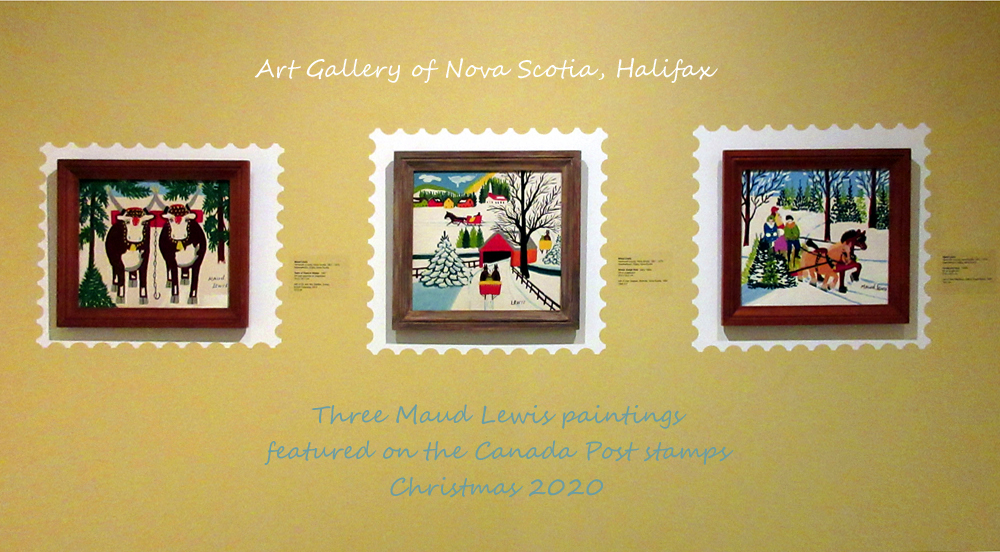
On November 2, 2020, in time for the Holidays, Canada Post issued three stamps featuring her winter themed paintings from the Art Gallery of Nova Scotia collection. All of the Christmas cards we mailed that year were adorned by these stamps.


In 2017, Mongrel Media and Sony Pictures Classic released Maudie. An award winning feature film of the life of Maud and Everett Lewis starring Sally Hawkins and Ethan Hawke. The movie was directed by Aisling Walsh. This film introduced Maud Lewis a much wider audience outside Canada. Receiving generally positive reviews with an approval rating of 89% on Rotten Tomatoes based on 151 reviews. Sally Hawkins gives an arresting performance as Maude. It won awards in all of the seven categories it was nominated for at the 2018 Canadian Screen Awards, including trophies for best actress, supporting actor, director, screenplay and best film. The film stimulated a resurgence and an interest in Lewis' work. It is currently available for streaming on Netflix.  

Maud Lewis was never really allowed to spend the money she made in order to make her life more comfortable. On the other hand, collectors of her work have been raking in the rewards for having a keen eye for art at a bargain. I remember seeing a few of her paintings being resold in commercial galleries in Halifax for about $4000 to $5000 during the 1990's. On November 30, 2009, her painting "A Family Outing" sold for $22,000 CND at a Bonham's Auction in Toronto. A painting found in 2016 at an Ontario thrift store, "Portrait of Eddie Barnes and Ed Murphy, Lobster Fishermen" was sold in an online auction for $45,000 CND. Click HERE. In May of this year, a painting entitled "Black Truck" made national headlines as it was traded during the 1970's to restauranteurs in exchange of a grilled cheese sandwich by a Maud Lewis art collector, an Ontario artist named John Kinnear. The story goes that Kinnear and his wife had lunch at the restaurant every day. And every time he ordered the same grilled cheese sandwich. Kinnear also kept in touch with Maud Lewis, sending her proper art supplies and boards. The painting was expecting to fetch as much as $35,000 CND at auction. But when the hammer fell, it went for 10X as much, for $350,000 CND. Full story HERE and follow-up HERE.

I've always been an admirer of Maud Lewis' artwork but doing an homage painting only appeared on my radar as a result of the pandemic. While we were restricted to the Atlantic bubble for travels because of the Covid-19, my wife and I did a few road trips within the maritimes provinces. In mid-September 2020 we visited the western portion of Nova Scotia. Our itinerary took us to various sites that had a direct connection with Maud Lewis. The background painting that appears in my own painting was the featured image for the month of August in the Maud Lewis 2021 calendar. Growing up in Cap-Lumière, NB, I could relate with the image since our house was located one mile from a similar looking lighthouse. In the calendar, it is referred to as "Lighthouse and Steamer", while in the art book Paintings For Sale by Sarah Milroy, as Untitled (Digby Ferry Passing Point Prim Lighthouse), 1950's. This lighthouse was located 14 km from the Lewis' house. 


The current Point Prim Lighthouse built in 1964 


The original Point Prim Lighthouse dates back to 1817. It was destroyed
by fire in 1873. The lighthouse that appears in the Maud Lewis painting
replaced the original. It was equipped with an attached lighthouse keeper's
residence. It remained in operation until 1964 when it was demolished and
replaced by the current lighthouse. 


When the province of Nova Scotia acquired the Painted House in 
1984, it also purchased its' land in Marshalltown. In 1997, a 
stainless steel framed structure was erected where the house once stood
and a memorial park was established on the remaining grounds.


This Painted House Replica was built by Ross Murray in 1999 on his 
property. Located on Route 217, seven km from where the original house once stood.
Amazing to see so much attention to details. The property also
included a shed and a mailbox. Being there and able to enter the house
and walk around the grounds was like entering a movie set. Completely surreal! 
Click HERE for backstory. 


Photo op in Yarmouth, NS - Birthplace of Maud Lewis - September 2020

My decision to use a Campbell's Soup can as the centerpiece was inspired by the Bob Brooks photo. She used the can to wash her brushes with turpentine. The one shown in the picture taken in 1965 would have been of the same period as when Andy Warhol did his 32 Campbell's Soup Cans in 1962. 

During the summer of 2020, we visited the Village Historique Acadien in Bertrand, NB. Among its' buildings is a replica of the original Nicholas D. Thériault General Store (1924). Almost every items inside are for sale for a few exceptions. The available inventory is meticulously curated by Mrs Lanteigne. While none are antiques, every items has a vintage flair. The top shelf had a display of can goods wrapped in vintage replica labels. When I spotted the vintage Campbell's Tomato Soup cans, my knees buckled. The label is probably pre 1930. When she told me that they weren't for sale, I was so disappointed but understood the situation. When we returned in 2021, I had forgotten about them, but upon seeing them again, my desire to acquire one was renewed. Fortunate for me, she remembered me and said she felt bad once I had exited the door. I had mentioned that I was a painter and wanted to incorporated one somehow in a painting. She kindly agreed to give me one, as long as I was willing to climb up the step ladder to get it. It was a fun moment and I was very thankful. 

I could have used a very similar soup can as in the photo of Maud Lewis, but opted for the retro can to create a narrative that linked her earlier years while her mother taught her how to draw, paint and play the piano when she lived in South Ohio, located 11 km north of Yarmouth.   


If you are still reading, hoping you enjoyed the ride!


This painting is currently on view in a group show entitled "Comfort and Joy" at the Fog Forest Gallery

-SOLD

Thursday, September 30, 2021

Acadia


"Acadia"
14 x 11", acrylic on mounted aluminium panel, 2021
painting #283

The Deportation Cross is located in Horton Landing Nova Scotia. It was conceived by René-Arthur Fréchette. In 1924, the gothic style cross was originally erected near a railway about a mile from the memorial church at the national historic site of Grand-Pré. In 2005, it was relocated to its current spot after archeologists determined and believed to be the exact location where the Acadians waited and boarded ships during the deportation of 1755.

This site along the Gaspereau River also includes the New England Planters Monument, dedicated to the settlers who took over the vacated land of Annapolis Valley between 1759 and 1768. A silvery ancient elm tree, believed to be 175 years old once stood only a few paces from the cross. The humongous tree was brought down during a powerful storm in November 2010. Years earlier, it had died from Dutch Elm disease and was bare of its bark and leaves. It had been hit by lightning a few times, still it stood and was admired for its resilience until the storm.  Artists Alex Colville and Tom Forrestall both painted the tree while it was still alive. In the 1984 NFB documentary film, The Splendour of Order, Alex Colville mentions that it was believed that the tree had stood there since the deportation of the Acadians. Colville has also painted the deportation cross while it was at its original location. During the same documentary, the camera follows him while he makes his way to the cross, makes a preliminary drawing and takes measurements. 


ALEX COLVILLE
"French Cross", 56.5 x 80 cm 
acrylic on hardboard,
1988, private collection

My wife Suzanne, Sept. 2020
Cross at its current location, Horton Landing, NS.

This painting is infused with symbolism. The imagery that appears on the Barbours baking powder tin can is of the Evangeline Well and commemorative church at Grand-Pré. Making this a sister painting to my previous post. Barbours is a family owned business right here in New Brunswick. It's as old as Canada itself. It was founded in 1867 in Saint John, NB by George L. and William Barbour. It is renown for its spices, baking ingredients, tea blends and mostly for King Cole Orange Pekoe Tea which was introduced in 1910. The business relocated to Sussex, NB in 1966. Of course, baking powder is one of the ingredients used to make the dumplings in a hearty Acadian fricot.

The site of the cross now serves as a memorial. The small folding seat/table belonged to my late mother. She specifically bought it to attend an outdoor mass celebrated by Pope John Paul II in 1984 during his papal visit to Canada and stop in Moncton. The yellow dandelions represents the Acadians past and present that remained rooted on their homeland. The dandelion globes, much like when a gust of wind breaks and separated the sphere, then spreads the seeds everywhere, represent the Acadians that against their will were deported mostly back to France and along the seaboard of the13 American Colonies.  

This is actually the second time I paint the Deporation Cross. The first time was in 2008 with my painting, "Reflecting on Being Acadian" when I painted Clive Doucet brilliant biographical book, Notes from Exile, featuring Alex Colville's "French Cross" on the book's jacket cover. Click HERE to view. 

This painting will be part of a small solo show entitled "Art-ifacts", hosted by the Fog Forest Gallery in Sackville, NB from October 14 to November 5, 2021.

 Unfortunately, in order for the gallery to remain open during the pandemic while keeping everybody safe, the gallery director and I came to the decision that it was safer not to hold an opening reception. The public however will be able to visit the gallery at their leisure during the run of the exhibition. The gallery is open on Thursday and Friday from 10 am - 5 pm. or by appointment.


14 Bridge Street, Sackville,
New Brunswick, Canada, E4L 3N5
Phone (506) 536-9000

Wednesday, October 23, 2019

Hibiscus in a Campbell's Soup Can, an homage to Andy Warhol


16 x 12", acrylic on mounted gessoed aluminium panel
painting #274, 2019

I first became aware of Andy Warhol's ''Flowers'' serigraph prints during the late 1980's when one of the many variations was featured predominately on the set of the CBS sitcom, Murphy Brown, starring Candice Bergan. 

After acquiring this Andy Warhol art book from the Taschen's Basic Art Series 2.0, I became curious about the backstory behind the image. Warhol would draw inspiration from a photograph of hibiscus flowers by Patricia Caulfield that appeared in a 1964 issue of Modern Photography. He was later sued in 1966 for the first time by the photographer for copyright infringement. Warhol was a very prolific artist. With the help of a few workers inside of "The Factory" (his studio), in one day, he could produce as many as 80 of these flowers silkscreens, printed in various sizes.  

L- photography of hibiscus by Patricia Caulfield
R- serigraph print of "Flowers" by Andy Warhol

For at least the past decade or so, we've been buying a hibiscus plant every spring for the veranda in front of our house. For the most part, the blooms only last one day or two, but it has several blooming cycles during the summer. This spring while stepping into our local Home Depot, they had a variety of dwarf hibiscus that is more of a potted flower than a potted plant. By the time I got back home, the concept for this painting came to me. I then acquired a Campbell's soup can on eBay from a US listing since here in Canada, the label was modernized more than a decade ago. I had initially intended to just do black background. Once it was done, the idea of using a modified version of Marilyn Monroe from Warhol's reversal series was introduced. I repeated the image as if it was wallpaper like Warhol did with Cows in 1966. 

This past July, after my wife Suzanne gave me the green light, I headed for Europe for three weeks to do some backpacking with our son Jean-Luc. This was his graduation gift for completing a bachelor's degree in business administration at the Université de Moncton. At the very beginning of the trip, we spent three days in Barcelona, Spain. As luck would have it, we were fortunate enough to view a serigraph print exhibition of Andy Warhol. The whole collection was owned by one individual, and was comprised mostly of many variations of Marilyn Monroe, Campbell's Soup Cans, Flowers and Mao Tse Tung. Click HERE for link. 


Painting to be shown this weekend at Art Toronto with Galerie de Bellefeuille (Booth A12)
Opening Night Gala: Thursday, October 24, 2019: 6:30 PM – 10:00 PM
Fair Hours: Friday, October 25, 2019: 12AM – 8:00PM
Saturday, October 26, 2019: 11:00AM – 8:00PM
Sunday, October 27, 2019: 11:00AM – 6:00PM
Location
Metro Toronto Convention Centre, North Building
255 Front Street West, Toronto
-SOLD

Friday, July 5, 2019

Cosmos & Coke

12 x 10'', acrylic on gessoed mounted aluminium panel
painting#271, 2019

The windowsill photo study used for this painting was taken in our kitchen about 8-10 years ago. In the background was an enormous cherry tree that has since been removed because of illness. The crop of cherries was always bountiful. Black birds and robins always enjoyed the fruits on the top branches.

When I spotted this green tinted drinking glass on a store shelf, its shape alone reminded me of a flower vase. Growing up in Cap-Lumière, NB, my mother and grand-mother always planted Cosmos flowers every spring. After the blooms were gone, they would collect the seeds for the following year.

To acquire this painting please contact:
To be exhibited in a summer group show starting later next week.
14 Bridge Street, Sackville,
New Brunswick, Canada, E4L 3N5
Phone (506) 536-9000
-SOLD 

Wednesday, September 21, 2016

Storm Brewing in a Teacup on Downton Abbey

12 x 16'', acrylic on gessoed hardboard
painting #241, 2016

Last month I received an invitation from the Fog Forest Gallery to submit a painting for a group exhibition that would give the viewer some respite in the wake of the current political uncertainty looming with the upcoming presidential elections in the US and the series of violence / terrorist attacks in the past year alone that seems to be on the uprise and constantly in the news. The exhibition is entitled ''Art for a World Gone Mad'' and runs from September 22 to October 15, 2016.

In my still life painting, entitled “ Storm Brewing in a Tea Cup on Downton Abbey”, I chose to document aspects of the critically acclaimed British television series and draw a parallel by allowing us to appreciate  how much the world has indeed changed in the past century for the betterment of humanity in most instances.  

Downton Abbey chronicles the life of the aristocratic Crawley family and exposes the lavish lifestyle of a disappearing elite class and the relationships they entertain with their many servants. But all is not so rosy at the Yorkshire castle. The main story line centers around the heir and descendants of the Earl of Grantham with their on-going struggles to financially sustain the domain as they meet the challenges of the modern world. Although the series is fictional, it does become quite credible as it follows the timeline in the UK during a very turbulent period in their history between 1912 and 1925.  Some of the events that filters through the script written by the show's creator Julian Fellowes include the sinking of the Titanic (1912), the ravages of World War I, 1914-1918 (17 million casualties, 20 million wounded), the 1918 flu pandemic, aka- Spanish flu (in excess of 50 million deaths), women's suffrage in 1918 (right to vote) and the Irish War of Independence (1919-1921).

The themes and drama that are explored in the six seasons are still pertinent today as they were back then and these include: social classes, snobbery, secrecy, sibling rivalries, woman rights/equality, political revolts, conflicts, infidelity, betrayals, feuds, murder, conspiracies, loyalty, blackmail, sabotage, bullying, scandals, racism, refugees, war and love.

The world in which we currently live in is fast paced and in a state of constant evolution. Much can be said about violence in its many forms, but many historians suggest that we are actually living in the most peaceful period of the past 500 years.  Advancements in human rights, technology and medicine alone makes the world a much better place than a century ago. 

The world economy, religious beliefs, the oil industry, control and power does rule the planet at this point and time. Terrorism, drugs, gun control, poverty, corruption, unemployment, politics of fear and division, global warming are some of the current issues we are faced with in 2016.  It's easy to get overwhelmed with the state of the world when we are constantly being bombarded by the media to a point where we become desensitized in order to cope.  While it is easy to reflect on the past when life appeared simpler, except it is not always true.  But one shouldn't lose hope because there is still a whole lot of goodness in the world today. 

As a painter, a great deal of my artwork does document aspect of popular and mass culture.  I do try to put a positive spin in the imagery. I've occasionally done paintings reflecting the economy or political climate by using a Monopoly Game board as a prop, which in turn becomes a form of symbolism.  I am not turning a blind-eye on all that is happening in the world today. We live in a world where we have to adapt in order to strive and move forward. We also need to take time for ourselves by taking care of our body, mind and spirit. I believe in the laws of Karma / the Golden Rule and try to do good, show gratitude, compassion and respect towards others.

With “Storm Brewing in a Tea  Cup on Downton Abbey”,  I've place a tea cup on top of a book that holds imagery detailing the work achieved behind the scenes with set decoration, costume and hair design, in recreating authenticity while filming the series at Highclere Castle.  The book was written by Emma Rowley and published by St. Martin's Press (2013).  The tea cup and saucer done in a Moroccan pattern is by Grace's Teaware. The setting is my own backyard. King Cole Tea is steeped locally by Barbour's in Sussex, NB. It has been widely renown as the favourite tea of Maritimers for the past century. 

I've actually watched the whole series of Downton Abbey twice. The first time, I binge watched the first four seasons on Netflix then tuned in on PBS for the remaining last two seasons. Then, I replayed the five seasons again on Netflix while I started this painting. I was hooked after watching just one episode. A combination of brilliant writing, a stellar cast and stunning cinematography helped create one of the most beloved and widely watched television dramas in the world. It's a serial where happiness is fleeting for most characters. The daily ritual of drinking tea is often the only constant they can rely on. Even while in the trenches of WWI, Thomas Barrow is serving tea to Matthew Crawley steeped from a cooking pot over a campfire. I leave you with words of wisdom from the matriarch of the Crawley family, Lady Grantham, brilliantly played by Maggie Smith.
''Just the ticket.  Nanny always said, Sweet tea is the thing for frayed nerves''
from Season 1, episode 3.
Fog Forest Gallery
14 Bridge Street, Sackville, NB
(506) 536-9000 
e-mail- gallery@nbnet.nb.ca
-SOLD

Thursday, May 22, 2014

Peonies for Emily

Acrylic on gessoed hardboard, 12 x 12"
Painting #221, 2014

For this painting, I decided to crop the image tightly and focus on the glass vase rather than the flowers themselves. The book is Canadian Paintings, Prints and Drawings by Anne Newlands published in 2007 by Firefly Books.

The art on the cover is by Emily Coonan (1885-1971), "Girl in Dotted Dress" c.1923, thus the title.

I can't recall seeing Emily Coonan's artwork in the past, so she was not familiar to me prior to the publication of this book. After doing some research, it felt appropriate to give her flowers since she was a pioneer Canadian woman artist during a time when woman in art were mainly perceived as hobbyists. She studied under William Brymner as did many others of her contemporaries. Along with like-minded modernist painters, she was associated with the short lived Beaver Hall Group in her native Montreal.  She and Lilias Torrance Newton were the first woman to be invited to show with the illustrious Group of Seven. She was also the first artist to receive a travel grant by the National Gallery of Canada in order to go to Europe.

This painting is currently on exhibition in a group show at the Fog Forest Gallery entitled "In the Garden", from May 22 to June 14, 2014.

Fog Forest Gallery 
14 Bridge Street, Sackville, NB. Canada
(506) 536-9000 or e-mail-gallery@nbnet.nb.ca .

-SOLD

Saturday, July 9, 2011

May blooms in a Mason Jar


Acrylic on gessoed hardboard, 18 x 14''
Painting #195, 2011

Yellow daisies, columbines, tulips and lilacs, these flowers are all perennials from our backyard garden. It's been two years already since my fast floral painting, and each time I find this subject matter somewhat daunting. I was truly compelled by the contrasts and backlight effect when considering this photograph I took for the study.

This painting is part of the Juried Exhibition 2011 which opened this week at the Moncton Gallery at City Hall. I haven't shown any artwork in Moncton, the city where I reside since 2007, so it a nice opportunity to remain in contact with the artistic community of Kent, Westmorland and Albert County.


SOLD by
Fog Forest Gallery 
14 Bridge Street, Sackville, NB. Canada
(506) 536-9000 or e-mail-gallery@nbnet.nb.ca .


Tuesday, October 13, 2009

Absolut Gerber Daisies

Acrylic on gessoed hardboard, #173
5 x 7'' - 2009

Absolut Vodka is a Swedish spirit that was first introduced in 1879. It accounts for 40% of all vodkas imported in the US. It's fame is very much attributed to the distinctive shape of its bottle and the longest running ad campaign dating back to around 1980. With full-page ads in magazines featuring the shape of the bottle in the center, with a tagline of ABSOLUT blank (at the bottom). See this Google link for imagery. Many flavors of vodka have been introduced since by Absolut, but the shape of its bottle has remain the same. With more than 1500 ads to date, no product has re-invented itself more over time. Even artists like Romero Britto and Andy Warhol have been involved as commissioned artists.

The setting for this painting is our kitchen window with the cherry tree in the backyard explaining the greenery.

Part of my solo show- Near & Far - October 16-30, 2009.
-SOLD