Showing posts with label Hergé. Show all posts

Saturday, October 2, 2021

The Bluenose II docks in Lunenburg

 The Bluenose II docks in Lunenburg
11 x 14", acrylic on gessoed mounted aluminium panel
painting # 285, 2021

This year marks the 100th anniversary of the launch of the original Bluenose schooner. The most recognized sailing, racing and fishing vessel in Canadian history. The schooner was designed by marine architect William James Roué of Dartmouth, NS. It was built in response to a rivalry between Lunenburg NS and Gloucester, Ma over which community built the fastest fishing vessel. The Bluenose would go on to win five International Fishermen's Trophy racing against its American challenger and remained undefeated for 17 years (1921, 1922, 1923, 1931 & 1938). 

Fishing schooners became obsolete during the 1930s, displaced by motor schooners and trawlers. During World War II, Bluenose remained at dock in Lunenburg. No longer profitable, the vessel was sold to the West Indies Trading Co. in 1942. The vessel was stripped of masts and rigging and converted into a coastal freighter for work in the Caribbean Sea, carrying various cargoes between the islands. Laden with bananas, she struck a coral reef off Île à Vache, Haiti on 28 January 1946. Wrecked beyond repair, with no loss of life, the schooner broke apart and was abandoned on the reef.

In 1963, a replica of Bluenose was built by Smith and Rhuland at Lunenburg using the original Bluenose plans and named Bluenose II. The project was sponsored by the Oland Company and used the iconic vessel as a marketing tool for Oland Brewery Schooner Lager beer brand and as a pleasure yacht for the Olands family. Bluenose II was sold to the government of Nova Scotia in 1971 for the sum of $1 or 10 Canadian dimes. The replica schooner is used for tourism promotion as a "sailing ambassador". The replica has undergone several refits to extend her life. This vessel was decommissioned and dismantled in 2010, and an entirely new Bluenose (also named Bluenose II, since Transport Canada deemed it a "reconstruction") was built as close to the original schooner deemed necessary and launched in Lunenburg in 2013. (Wikipedia). 

Bluenose has adorned the Canadian 10-cent coin almost exclusively since 1937. It's featured on Nova Scotia's current licence plate and has appeared on four previously issued Canadian stamps. Bluenose is also one of the very few non-human inductees in the Canada's Sports Hall of Fame


 50 cents Canadian Stamp - 1929


Canadian dime featuring Bluenose since 1937


Centennial commemorative Canadian stamps, issued June 29, 2021 


The photographic reference for the painting was taken last September during a one week getaway in Nova Scotia. I could have done the bow of the ship which is even more iconic, but it didn't have the same visual impact and was far less detailed. The bow could have been done in a fraction of the time it took to paint all of this tedious details since I also had to be as accurate as possible. I did edit out a lot of rope that was coming in every direction to have a more aesthetic and clean look. 

Bluenose II, Lunenburg, NS, Sept. 2020

Captain Archibald Haddock from the Tintin serial by Hergé also celebrates an anniversary in 2021. He was first introduced in the graphic novel The Crab with the Golden Claws in 1941, 80 years ago. Captain Haddock is an alcoholic although he does sober up at times. His drink of choice is whiskey. I chose a Jameson bottle for several reasons. It has a tall ship and anchors on the label, the green color glass and the way it plays with the light. I also had a chance to visit the distillery in Dublin two summers ago with my son Jean-Luc, part of a 3-week European trip. 


My son Jean-Luc, Jameson Distillery
Dublin, Ireland, July 2019


This painting will be part of a small solo show entitled "Art-ifacts", hosted by the Fog Forest Gallery in Sackville, NB from October 13 to November 5, 2021.

Unfortunately, in order for the gallery to remain open during the pandemic while keeping everybody safe, the gallery director and I came to the decision that it was safer not to hold an opening reception. The public however will be able to visit the gallery at their leisure during the run of the exhibition. The gallery is open on Thursday and Friday from 10 am - 5 pm. or by appointment.


14 Bridge Street, Sackville,
New Brunswick, Canada, E4L 3N5
Phone (506) 536-9000

Friday, October 26, 2018

POP Goes the World

14 x 11", acrylic on gessoed mounted aluminium panel
painting #267, 2018

Frederic Tuten (b.1936) is an American novelist, writer, art and film critic. Tuten was a friend of both Hergé and Roy Lichtenstein. He has published several essays on the work of Lichtenstein as well as catalogues of other artists such as Eric Fischl. With the permission of Hergé, Tuten took Tintin and plunged him into a coming of age adventure, this time going to Machu Picchu with Captain Haddock and Snowy. The narrative follows Tintin as he meets and falls in love with Clavdia Chauchat, which for the first time in his life will awaken and arouse sexual desires. During this process, a metamorphoses occurs as he shed his physical image of a boy-man. This dream-like escapade with political overtones included four characters taken from Thomas Mann’s 1924 novel, “The Magic Mountain”, of which Clavdia Chauchat is among the cast. Prior to this novel, Tintin had always retain the image of being asexual throughout the comic book series

The novel, “Tintin in the New World” was published in 1993, a decade after the passing of Hergé. However, chapters of Tintin in the New World had first appeared in it's entire form in Fiction (1975), Tri-quarterly (1975),  Syntaxis (1984), Artform (1984) and De Brakke Hond (1984). It is perhaps Tuten's best known and most critically acclaimed work. It has been translated into six languages and has gone through several print runs. I had a chance to read the novel during a recent vacation and am in agreement with several critiques I've read on-line which were mixed. Tuten will be publishing a memoir, My Young Life, slated to arrive in bookstores in March 2019.

Roy Lichtenstein had previously done artwork for a book cover of Tuten’s 1971 novel, The Adventures of Mao on the Long March. The artwork that appears on the cover of Tintin in the New World was especially done for the novel in 1993 and is entitled “Tintin Reading”. I only discovered the existence of the Tuten/Lichtenstein collaboration this past August by happenstance. 

I had acquired the collectible figure of Tintin reading in the big red armchair two years ago upon visiting the Tintin Boutique in Brussels, Belgium. "Coffret at home" was inspired from the pages of the graphic novel “L’oreille cassée" (The Broken Ear), published in 1937, page 10 and 11. Tintin was originally holding a book entitled “Voyages aux Amériques” by Ch. J. Walker, Graveau éditeur, 1875. I decided to play with the narrative and have Tintin read his own adventure in Tuten's novel instead.


In the beginning of the novel, it is revealed that Tintin is an art collector and is amassing a collection which includes Danse by Henri Matisse which appears in the artwork. 
Capitain Haddock: "What about your art collecting? Have you given that up, too? All those unopened crates of paintings you've left unexamined: that Matisse you spent ages to acquire- that one with all those naked dancing people- still in its shipping case."
 Photographed during a visit at the MOMA, NYC, Dec. 2015


Lichtenstein had previously drawn inspiration from Matisse's masterwork when in 1973, he incorporated The Dance in a very large scale painting entitled, Artist's Studio- The Dance.

Artist's studio - The Dance, 1973
magna, oil on canvas, 243.8 x 325.1 cm
collection of the MOMA, NYC


Sculptor Seward Johnson is another artist whom was inspired by Matisse's The Dance and created multi-pieces 3-dimension bronze sculptures that included Matisse himself painting on a canvas and models. 

Seward Johnson
photographed during a trip to Key West, Florida
March 2011. 

This painting marks the first time that I have use the camera from my iPod Touch to do the photo study for the painting.
  
Trivia- Lichtenstein's Tintin Reading was also used for a retrospective of his work held at the Musée des Beaux-Arts in Montreal in 1994.


This is my second of two paintings that will exhibited at Art Toronto with La Galerie de Bellefeuille of Montreal. The exhibition will be held from October 26 to 29, 2018 at Metro Toronto Convention Centre, North Building, 255 Front Street West, Toronto.
-SOLD

Thursday, October 25, 2018

L'as du volant ( The Driving Ace)

12 x 12", acrylic on mounted claybord
painting #266, 2018

Where does inspiration come from? For me it is often from getting a visceral response when I see something. I'll make a mental note, then eventually when other elements present themselves, much like making a small jig-saw puzzle, the image is revealed to me as a concept.

It is funny how a mundane moment can inspire a painting. During my month long vacation in Europe this past May, I met a lady from La Rochelle, France while on my two-week, 330 km hike on the Camino. When I told her that my French ancestor, Michel Richard crossed the Atlantic in 1652 from La Rochelle, she replied that her first husband was actually a Richard and both of her children have Richard as their family name. After my return home, I received a friend request from her on Facebook. Some time had passed when she wrote me a short note on messenger to see what I was up to. She mentioned that their lives had return to normal and her husband was re-joined a club to play Tarot. I only knew Tarot as cards used for divination or fortune telling. 

When I Googled French Tarot, I learned that it is a card game using strategy played with 4 players. Among the Google images that appeared on screen was the French card game “Mille Bornes”. I got an immediate visceral response upon seeing this nostalgic game and the wheels started turning. Thirty minutes later, I would find a Tintin at the wheel of a race car on eBay. The die-cast car that also features Snowy and the Thompson Twins was inspired from the comic book, “Les cigares du Pharaon” (Cigars of the Pharaoh), page 66. I would also acquired a 1971 edition of Milles Bornes on eBay. I wanted to use this edition since it was that one that I played during my youth. 

Hergé's comic strip from "Cigars of the Pharaoh)


Milles Bornes was created by Edmond Dujardin in 1954, with the card illustrated by Joseph Le Callennec. This card game based on a road trip is for 2 to 6 players, usually played by 4 players, 2 on each team, as a partnership. The object of this game is the first player or team to accumulate a total of exactly 5000 points in several hands of play. In so doing, players try to complete trips of exactly 1000 km/miles= 1000 points in each hand played. The term "Bornes" refers to the kilometre milestones found on many roads in France and Europe. 

My son Jean-Luc on a roadside borne in France, 2006


During my research, I also found a special edition of Mille Bornes based on The Adventures of Tintin. Ironically, as I was searching for an image for this blog post, the same sports car with our merry cast is featured on one of the cards. 


Trivia- The pop band Thompson Twins,  part of second British invasion of the 1980 was named after the two bumbling detectives Thomson and Thompson from Hergé's comic books.

This is one of two paintings that will exhibited at Art Toronto with La galerie de Bellefeuille of Montreal. The exhibition will be held from October 26 to 29, 2018 at Metro Toronto Convention Centre, North Building, 255 Front Street West, Toronto.
-SOLD


Monday, December 18, 2017

Et Hergé créa Tintin


Acrylic on gessoed mounted aluminium panel, 14 x 11''
painting #257, 2017

This painting was inspired after viewing the exhibition, Hergé à Québec held at le Musée de la Civilisation in Québec City in late September. Last year we had planned to visit le Musée Hergé in Louvain-la-Neuve, 32 km outside of Brussels but our bus tour was cancelled at the last minute when my wife and I were they only ones who had booked on that day. Everything happens for a reason, so if we can't go to the museum.....let the museum come to us. 

This travelling exhibition was organized by le Musée Hergé. After stops in Paris, London and Geneva, the city of Québec was honoured and excited to host the show for a five month stint. Hergé à Québec was seen by 420,593 visitors, breaking the record for the most ticket sold in the museum's 30 year history. 


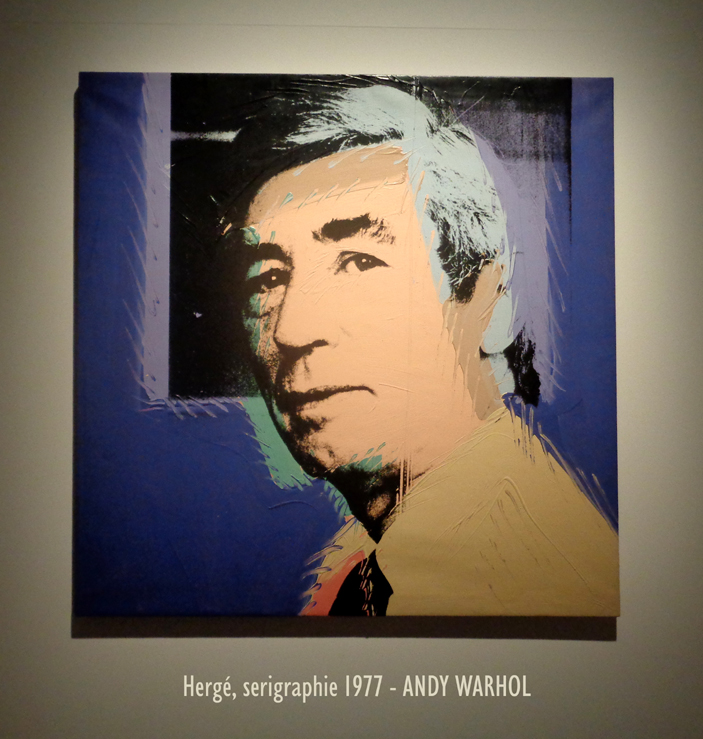
Hergé meets Andy Warhol in NYC, 1972


The exhibition explores the world of Georges Rémi, the talented Belgian born artist known as Hergé who created Tintin and other comic strips. Among the show's treasures was of a selection of valuable documents and artefacts of his life, original drawings, storyboards, 3D-models, illustration art from his early artistic career, a selection of his own private art collection and a mural of books of The Adventures of Tintin translated in 70 languages.


Mural of The Adventures of Tintin books


Model of the Rocket featured in two books


In this composition the museum plan and exhibition leaflets were the jump off points that ignited the narrative. A wonderful picture of Hergé by Belgian photographer Robert Kayaert (1920-2007) graced the covers of both.  The small figurines of Tintin and Milou (Snowy) were eBay purchases I had acquired a few years ago who were waiting in the wings, while a set of pencils were purchased at the Museum Gift Shop upon exiting the exhibition, unsuspecting that they would soon appear in a painting. The background imagery is from the book, Musée Hergé with preparatory drawings and final illustration for Tintin in Tibet. The book was a Christmas gift from my wife two years ago purchased that same fall at le Salon du Livre in Shippagan, NB (Book Fair). 


Selfie at le Musée de la Civilisation, Québec

The painting will be on display at Galerie de Bellefeuille in Montreal in early December, 2017.

-SOLD