Showing posts with label Elliott Fouts Gallery. Show all posts

Tuesday, December 17, 2013

Nostalgic Candy


Acrylic on gessobord, 14 x 11"
Painting #219, 2013

I came across this candy jar at Chapters Book Store during the fall of 2012. It was priced at $15, but probably contained two dollars worth of candies. The art of presentation and packaging really caught my eye which compelled me to buy it. The translation in French of Nostalgic Candy for the Canadian market should be "Bonbons nostalgiques". "Friandises d'antan" translates to Treats of Yesteryear in English which sounds equally sweet. 

The art book that anchors the composition is one of those amazing Taschen indispensables written by Kerstin Stremmel. The frontispiece for Realism is Gumball XV (detail) by Charles Bell. The first time I witness a solo show by a Photorealist was Charles Bell at the Louis K. Meisel Gallery in New York City during the month of November, 1994. This is a nostalgic homage to Bell, the type of artist I technically aspired to become in the earlier stage of my artistic career.  At the time, it just seemed quite impossible to paint like that. The book itself is a general overview on Realism with the likes of Eric Fischl, Lucien Freud, Edward Hopper, Tamara De Lempicka, Georgia O'Keefe, Gerhard Richter, Charles Sheeler, Grant Wood among others and two more Photorealists- Chuck Close and Richard Estes. 

This painting will be part of the 15th Anniversary Celebration Group Show of the Elliott Fouts Gallery running from January 4 to February 6, 2014. 


Participating gallery artists also includes: Christopher Stott, John Karl Claes, Gale Hart, Susan Hoehn, Bryan Mark Taylor, Anthony Montanino, Joe Santos, Kathy O'Leary, Deborah Bonuccelli, Vito Antonio Ferrante, Sandy Delehanty, Samantha Buller, Gary Pruner, Philippe Gandiol, Susan Shoger, Kathrine Lemke Waste, Terry Pappas, Judy Nunes, Manuel Nunes, Teresa N. Fischer, Gregory Kondos, Micah Crandall-Bear, Vic Vicini, Bill Chambers, Randy Brennan, Tod Steele, Jeff Nebeker and Tim White.


photo provided of EFG


Elliott Fouts Gallery
1831 P. Street Sacramento, California, USA , 95811 
Phone (916) 736-1429 
e-mail: efgallery@sbcglobal.net

-SOLD

Saturday, October 5, 2013

American Art Collector #96 / The Still Life Invitational

 American Art Collector - October 2013

My artwork currently appears in the October 2013 issue of American Art Collector (#96) on pages 124-125 as part of The Still Life Invitational, opening today at the Elliott Fouts Gallery in Sacramento, CA. This exhibition has been held annually during the month of October since 2010, and I've had the privilege to take part in all four editions.  


L- Life in Delft, gifts for Griet, 12 x 12", acrylic, 2013 - SOLD l
top R- Mondrian Tumbler, 11 x 14", acrylic, 2013 - SOLD l
bottom R- Peanuts come to Life, an homage to Charles Schulz, 11 x 14, acrylic, 2013 -SOLD l

This year's other participants includes the talented Bryan Mark Taylor, Christopher Stott, Elizabeth Barlow, Jelaine Faunce, Joanne Tepper, Judy Nunes, Leigh-Ann Eagerton, Teresa N. Fisher, Todd Ford & Vic Vicini. 

My three entries as shown in the image above will be included in the group show that runs from October 5-31, 2013.


To inquire about these paintings please contact:
Elliott Fouts Gallery  
1831 P. Street Sacramento, California, USA , 95811
Phone (916) 736-1429
e-mail: efgallery@sbcglobal.net

Sunday, September 22, 2013

Life in Delft, gifts for Griet


Acrylic on gessoed hardboard, 12 x 12"
painting #216, 2013

Girl with a Pearl Earring is one of the world's most famous paintings. It's has often been called the Dutch Mona Lisa, or the Mona Lisa of the North. This Johannes Vermeer's (b. 1632, d. 1675, Delft, Holland) painting has been copied countless times by other artists or incorporated in various fashion in original pieces of art by many others. Little is known about Vermeer's life. Many of the models whom have posed for his paintings have never been specifically identified. With the passing of time, he was forgotten after his death. His artwork only came to light 200 years later. He is regarded as one of the greatest painters of the Dutch Golden age.  

Some speculates that the model used in ''Girl with the Pearl Earring'' might have been Magdalena Van Reijven, an art patron's only daughter or Maria, the artist's eldest daughter of which he had 11 children. My approach for this painting was to explore the unknown model behind the painting that was brought to life in Tracy Chevalier's fictional 1999 novel of the same name whom was given the name of Griet. I first came upon the novel in 2003, just prior to the film release based on the source material. The storyline is from the point of view of Griet, a very young woman who goes to work as a servant in the Vermeer household after her own father, a potter and tile maker suffers severe burns from a kiln explosion. The imaginary narrative leads to how she came to pose for Vermeer and the relation she entertained with the artist and his family during her brief stay there.

Chevalier paints life in Holland with a lot of historical details and nuances giving it a sense of authenticity and believability. I read the book with immense interest. When the film was released in theatres it became a magical visual spectacle of what life in Delft during the mid 17th century might have been like. Being able to venture inside a make believe Vermeer studio and how they brought everything to life is a visual feast for any painter. The movie itself was not filmed in Delft but on an existing movie back lot in Luxenbourg. The period film stars Scarlett Johansson and Colin Firth in the lead roles, and was directed by Peter Webber. Johansson was nominated for a Golden Globe and a BAFTA for best actress and did win the BAFTA that year but for another film, Lost in Translation.  I loved the fact that they were able to find an actress to play the role of the other servant named Tanneke, who looks exactly like the model in Vermeer’s ''The Milkmaid''. Other details like Vermeer's possible use of a camera obscura to create source imagery for his painting.


Description of pigment used for paint colour. In one scene when art patron Master Van Ruijven confronts Vermeer upon viewing the new commission painting his wife Emily, ''Woman with a Pearl Necklace'', he asks, ''Is this Indian yellow.....distilled from the urine of sacred cows fed only on mango leaves? You glazed my wife in dried piss!".  Interesting titbit, on Wikipedia, Van Ruijven's wife name was named Maria de Knuijt.


My painting, it is as much of an homage to Vermeer, but even more so to Tracy Chevalier. In order to create a visual narrative that was based on the Griet character during the final scene in the novel/film, I had the idea of incorporating a new tile to replace the one given by her father that had been broken by one of Vermeer's jealous daughter. While browsing on eBay I found this amazing hand painted Blue Delft tile with the scene of the city itself. It is also known as Delftware or Delft earthenware. The tear drop pearl earrings I used were also an eBay find from a seller living in China.  In the final scenes of the film, Griet leaves the Vermeers to return home, crosses a canal on a arch bridge and then soon after, Tanneke arrives at her house and she is given the pearl earrings as a gift from the artist. In the book, Griet does receive the earrings as a gift, but the circumstances are much different. Since the Blue Delft tile features row houses, a canal and an arch bridge, it really contributes to the narrative for my composition. 

Girl with Pearl Earring, c. 1665
Johannes Vermeer
Mauritshuis, The Hague

In real life, Pieter Van Ruijven had amassed approximately 20 of Vermeer's paintings during his lifetime. After his death, and that of his heirs these were sold at auction in 1696 for approximately 70 guilders each.  Arnoldus Andries des Tombe, a Dutch army officer later purchased ''Girl with a Pearl Earring'' at an auction in The Hague in 1881, for only two guilders and thirty cents. At the time, it was in poor condition. Des Tombe had no heirs and donated this and other paintings to the Mauritshuis in 1902. In the movie, the painting being acquired by Van Ruijven is ''Woman with a Pearl Necklace'' with his wife Emily modelling the same type of pearl earrings as in ''Girl with a Pearl Earring''. The two models also share the same facial features upon close examination. Personally I think that the model in both of these paintings is the same person. The turban she wears only adds an element to distract the viewer. Furthermore, these two paintings are dated one year apart. Then again, the same pearl earring appear in several other paintings on different models as does the ermine-trimmed yellow jacket shown below. 


Woman with Pearl Necklace, c.1664
Johannes Vermeer
Gemäldegalerie, Berlin

The Mauritshuis Museum is undergoing major renovations and is closed until mid 2014. However, a few masterpieces of the museum including ''Girl with a Pearl Earring'' is currently on tour in the USA. Earlier this year these were shown at the deYoung Museum in San Francisco. They are currently at the High Museum of Art in Atlanta and later next month will be travelling to The Frick Collection in New York City. 

I am a great admirer of Vermeer's artwork. Only 34 paintings have been attributed to him (view them HERE). During my travels, I've had the privilege to see 22 of them. These are housed at the Rejksmuseum in Amsterdam, the National Gallery in London, the Louvre in Paris, the National Gallery in Washington, DC, the Isabella Gardner Museum in Boston, the Frick Collection and the Metropolitan Museum of Art both in New York City. My personal favourite is ''Milkmaid''. 

And yes, I did use Indian Yellow in bringing Griet to life.


This painting will be included in the upcoming group exhibition, The Still Life at the Elliott Fouts Gallery, October 5-31, 2013.

______________________________


Update: 

Not all Friday the 13th are unlucky. This past May 13 2016, I've had the immense pleasure of visiting the Mauritshuis in The Hague. The following day, my wife Suzanne and I strolled the canal streets in Delft. My longing to visit the land of Vermeer finally came to be during a 2-week backpacking trip of Belgium, The Netherlands and Norway. 


 The Mauritshuis (Art Museum), The Hague


 Girl with a Pearl Earring - Johannes Vermeer
The Mauritshuis


The Mauritshuis


 Location as featured on the Delft Blue tile in my painting, Delft Holland


Delft, Holland


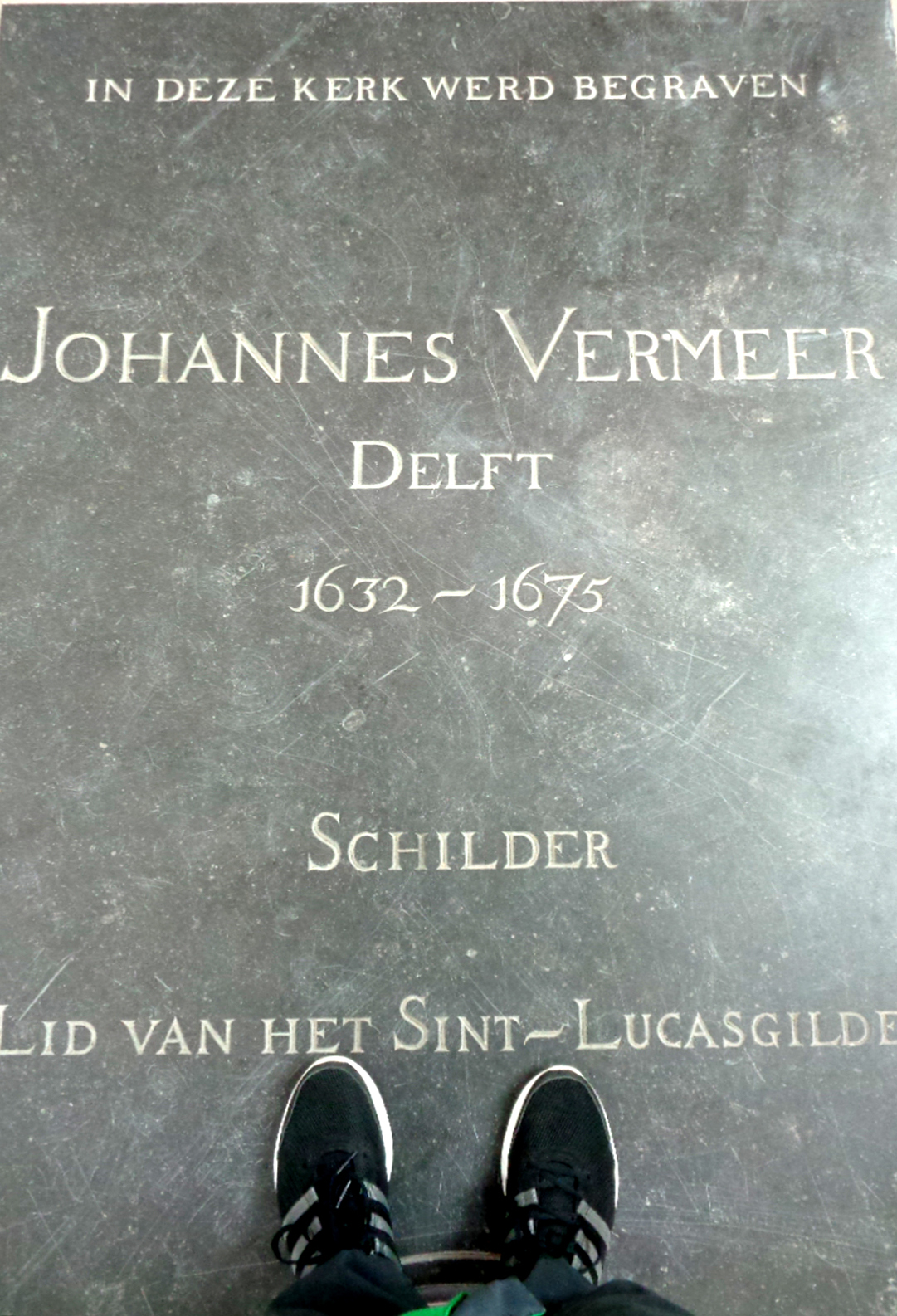
 One of two tombstones of Johannes Vermeer inside
the Oude Kerk (Old Church), Delft. 


Painting on loan from the Rijksmuseum, Amsterdam


Elliott Fouts Gallery
1831 P. Street Sacramento, California, USA , 95811 
Phone (916) 736-1429 
e-mail: efgallery@sbcglobal.net
-SOLD

Sunday, August 5, 2012

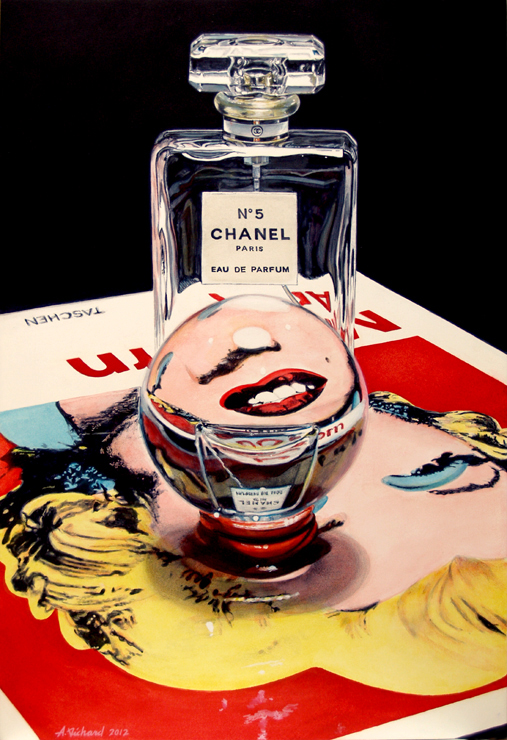
Famous for More than Fifteen Minutes

Acrylic on gessoed hardboard, 16 x 11''
painting #209, 2012

Today, marks the 50th anniversary of Marilyn Monroe's untimely passing at the age of 36. The circumstances surrounding her death has been the subject of much speculation and mystery. There are a few actresses of the golden age of cinema that still continue to mesmerize me and these include- Marilyn Monroe, Ingrid Bergman and Grace Kelly. For Marilyn, her vulnerability and timeless beauty captured both on film and in photography makes her immortal. Her ever growing appeal continues to fascinate half a century later. 


Ed Feingersh photography

 The genesis for this painting was ignited after viewing two films this past February. My week with Marilyn for which Michelle Williams received a Golden Globe and an Academy Award nomination and the 2009 film Coco before Chanel starring Audrey Tautou.  A most famous photograph of Marilyn taken by Ed Feingersh was the catalyst that sparked the whole concept. In the 1950s the glamour of Chanel No. 5 was reignited by Monroe, whose unsolicited endorsement of the fragrance provided invaluable publicity.“What do I wear in bed? Why, Chanel No. 5, of course,” the Daily Mail quoted Monroe as saying in the ad. In another 1994 ad, model Carole Bouquet was morphed into Marilyn for a clever Chanel No. 5 video commercial. (click HERE to view)


Coco Chanel

Coco Chanel was born Gabrielle Bonheur Chanel in Saumur, France in 1883. She first branched out into fashion as a hat designer. She revolutionised the fashion industry with menswear-inspired design done in simple elegance which made her a rebel in the 1920's and 30's. She rejected a lot of the feminine fashion of her day and created a more androgynous look. Her House of Haute-Couture became famous for her tweed suits, little black dress, costume jewellery, top-stitched bags, chain belts and of course the world's most famous perfume, Chanel No.5 The scent was developed by Russian-French chemist and perfumer Ernest Beaux. In 1921, the perfume's first 100 bottles were given as Christmas gifts to her best clientèle. The following year, it was made available to the general public, marking 90 years in 2012.  A bottle of Chanel No.5 is sold every 30 seconds.


After doing a bit of research I realized that I was also able to pay homage to my favourite Pop artist Andy Warhol, who's anniversary of his death also coincides with the milestone year of 25. And tomorrow, he would have turned 84.


The Chanel No. 5 bottle, over decades, has itself become an identifiable cultural artefact, so much so that Andy Warhol chose to commemorate its iconic status in the mid-1980s with pop-art silk-screens.  Even empty, the bottle are highly collectable. It would take me more than two weeks to acquire one on eBay that was not going to cost upwards of $20. For it's 75th anniversary, Chanel issued a special edition of No.5 using one of Warhol's serigraph images on the box that holds the decanter. The title for the painting was inspired by the famous Warhol quote, ''In the future, everyone will be world famous for 15 minutes''


The image of Monroe used in the painting appears on the cover the slip case of a massive two-volume book set entitled ''Modern Art'', published by Taschen in 2011. (Marilyn, 1964, silkscreen on canvas 40'' x 40'' by Andy Warhol). I came across these books at the Museum Shop of the Phillips Collection in Washington, DC during a visit this past Easter. Since I was travelling light with only a backpack, at a hefty 11 lbs, I opted to buy it on-line through Amazon.com upon my return. For this composition I used a crystal ball much like a clairvoyant would do to channel their spirits. The lives of all three did become intertwined because of their fame. All three are iconic figures of popular culture for the significant contribution to the arts.

On a personal note- Monroe died in 1962, seven months after I was born. Warhol died on February 22 1987, the same month I completed my first original painting. In 2006, we vacationed three days in Oiron, France to visit a family friend living there. We spent a full afternoon in Saumur where Coco Chanel was born, visiting châteaux along the Loire River in this very scenic town with black slate roofs.

This painting will be exhibited in ''The Still Life'' Invitational group show during the month of October at the Elliott Fouts Gallery in Sacramento, California. Details to follow.

Elliott Fouts Gallery
1831 P. Street Sacramento, California, USA , 95811 

-SOLD

Wednesday, February 29, 2012

Caboose on Pennsylvania Railroad

Acrylic on gessoed hardboard, 8 x 10''
Painting # 207, 2012

The only toy that I've kept from my own childhood is an electric toy train set, comprised of a steam engine, three wagons and a caboose. This Mantua train set was given to me by my next door neighbour when I was about 12 years old. It belonged to her youngest son who was more than 10 years my senior. At the time, he had moved out of the homestead and his mother came upon it while cleaning out the remaining of his stuff. I would estimate that it is close to 50 years old. 

When I started to read about the Pennsylvania Railroad Company on Wikipedia, the genesis for the composition came to me.  The Pennsylvania Railroad (PRR) was founded in 1846. It's headquarters was located in Philadelphia, PaThe PRR was the largest railroad by traffic and revenue in the U.S. for the first half of the twentieth century and was at one time the largest publicly traded corporation in the world. At its peak it controlled about 10,000 miles (16,000 km) of rail line. At one point the budget for the PRR was larger than that of the U.S. government and at its peak it employed about 250,000 workers. In 1968, it would merge with it's rival, the New York Central Lines to form the Penn Central Transportation CompanyThe Interstate Commerce Commission required that the ailing New York, New Haven and Hartford Railroad be added in 1969. A series of events including inflation, poor management, abnormally harsh weather conditions and the withdrawal of a government-guaranteed 200-million-dollar operating loan forced the Penn Central to file for bankruptcy protection on June 21, 1970. The Penn Central rail lines were split between Amtrak and Conrail in the 1970s. After the breakup of Conrail in 1999, the portion which had been PRR territory largely became part of the Norfolk Southern Railway.


This painting chronicles in a whimsical way, the Pennsylvania Railroad Company during it's 122 years of operation from 1846 to 1968. I've been collecting stamps since my early teens. I've always viewed them as miniature artworks, so as the previous painting, I'm incorporating a very appropriate stamp in the composition. This first-day cover does not exist in real life. I took bits and pieces from of other medias to fabricate an imaginary first-day cover marking the last day (January 31, 1968) the company operated before merging with it’s rival, the New York  Central  Lines.This US stamp was actually issued at 32¢ on May 28, 1998, to celebrate the ''Electric Toy Train''. From a timeline of the US Postal Services, the cost for mailing a first-class letter in 1968 was 6¢, so I changed the amount accordingly for the painting.  

1998 US- 32¢ stamp celebrating the 
''Electric Toy Train'' used in the painting

I chose Atlantic City, NJ for the postmark, since the PPR once served the city and it is the setting for the Monopoly game on which the composition in anchored on.  The lone caboose serves as a sign of the times. Until the 1980’s, laws in the US and Canada required that all freight trains had a caboose and a full crew for safety. Technology eventually advanced such and in effort to save money and reduce crew members, it was stated that the caboose was unnecessary and their use has since declined and they are seldom seen on trains, except on locals and small railroads.

The Pennsylvania Railroad Museum which is located east of Philadelphia, outside of Strasbourg Pa in Amish country. In relation with my previous painting, Lucky Lindy flies the Airmail, that museum is currently restoring ''The Lindbergh engine'', PRR #460. During his first stop in Washington, DC on June 11, 1927, after returning from Europe and his transatlantic flight, Charles Lindbergh was promoted to colonel and awarded the Distinguished Flying Cross by President Calvin Coolidge. Two rival newsreel companies, who were each vying to be the first to have their films of the ceremony shown in New York theatres before Lindbergh's visit to the Big Apple two days later, chartered a train and an aircraft, respectively, from Washington to New York City. No. 460 headed up the charter train, pulling only its tender, a baggage car and a passenger car. The train departed Washington at 1:14 PM and arrived at the Manhattan Transfer, outside of New York City, 2 hours and 56 minutes later. Even though the aircraft arrived in New York first, the film brought by No. 460 was in theatres hours before the other, thanks to a film processing lab on board the baggage car.

This completes the trio of paintings for 
the ''Planes, Trains and Automobiles'' Invitational group show 
at the Elliott Fouts Gallery, Sacramento, CA, March 3- April 5, 2012.

Elliott Fouts Gallery
4749 J. Street Sacramento, California, USA , 95819 
-SOLD


Sunday, January 29, 2012

9-11 on a Dice Roll

Acrylic on gessoed hardboard,11¼ x 14¼''
Painting #205, 2012

This past September I was invited by the Elliott Fouts Gallery to take part in a group exhibition entitled ''Planes, Trains and Automobiles'' scheduled to open on March 3. The idea of using a Monopoly game board came to me during the following week as I was driving to the Greater Moncton Airport to pick up a family friend who was on a returning flight from Montreal. Upon taking the airport exit, you have to cross a railroad track to get to the terminal. So there I was, in an automobile, crossing a train track, to get to a plane.

My initial idea was using one of the four railroad spaces on the Monopoly game board. But the concept changed once I was able to acquire a plane and a train token on eBay. The locomotive engine token is part of the Monopoly ''70th Anniversary'' edition, while the jet plane game piece is from the Monopoly ''Here and Now'' edition. All three token have different finishes, the car has a semi-luster metallic finish, the train has a chrome finish while the plane is made of pewter.

As I was setting up the board game for the initial photo study and started moving the pieces around, the whole narrative came to me when I dropped the jet plane on New York Ave. I felt my heart sinking and it became a very unsettling moment. At the same time, it felt too important to dismiss. By the time I was done setting up the props, my initial concept would take on a whole new direction. The image may seem whimsical on the surface but has many cross references. The first serving as a 9-11 memorial on lives lost, the many injured and those left behind.  The 2001 World Trade Center disaster was also an attack on democracy and freedom, and the aftermath would immediately impact air travel, airport security and cross border crossing on a global scale. The count of dots on each dice totals 9 + 11,  and the two hotels are in reference of the Twin Towers. 

September 11, 2001 is forever etched in our consciousness. I was driving to Fredericton, NB to view an art exhibit at the Beaverbroook Art Gallery when I heard the drama as it unfolded live on radio. Later that evening and for the following days, I just sat in a numb state, transfixed and in disbelief in front of the TV set, absorbing the surreal video footage being replayed which also included two other passenger planes, one that targeted the Pentagon in Arlington, Va and a fourth (United Airlines Flight 93) that crashed into a field near Shanksville, Pennsylvania. The repercussions of the September 11 terrorist attacks are all immeasurable in the emotional, financial and physical realm. It would later lead indirectly to the U.S. wars in Afghanistan and Iraq, as well as additional homeland security spending, totaling at least $5 trillion.


A year later, I would visit ''Ground Zero'' where the World Trade Center once stood. Seeing the cross made from recovered steel beams rising above the ashes like a Phoenix was an overwhelming sight. As was the banged- up Sphere Sculpture that once stood outside the World Trace Center (surrounded by a water fountain) that was recovered in the wreckage and installed as a memorial site next to an eternal flame as the centerpiece of the Hope Garden in nearby Battery Park. 
                                                       
The Train engine on Kentucky Ave is in reference to the ''Blue Grass State'' for having the most productive coal field in the US and for it's mining history. Coal was the primary source of fuel for steam engine locomotive prior to WW2 before eventually switching to gasoline, diesel and electricity. Kentucky is also the fourth largest producer of automobile in the United States. The Chevrolet Corvette, Cadillac XLR, Ford Explorer, Ford Super Duty truck, and the following Toyota vehicles: Camry, Avalon, Solara and Venza are all assembled here.

And of course the little roadster is on ''Free Parking'', since ''the Best things in life are still FREE'', including a smile. There is currently a price to pay for clean air, clean water and personal freedom. The top numbers on the dices equal seven as a symbol that we can still count our many blessings even when life has many unexpected turns.

Trivia
-In the Monopoly ''Here and Now'' edition, the railways have been replaced by the four    
 largest airports in the US. The tokens have also been revamped. The Scottish Terrier has   
 been bumped by a Labradoodle, the boot by a New Balance sneaker, the car by a Toyota 
 Prius, there is also a large McDonald's fries, a Starbucks Coffee mug, a Motorola cell  
 phone and a laptop computer.
-Tokens from the Monopoly US ''Here and Now'' Edition were flown into space aboard  
 Space Shuttle Atlantis in 2007.


''Planes, Trains and Automobiles'' Invitational group show 
at the Elliott Fouts Gallery, Sacramento, CA, March 3- April 5, 2012.

-SOLD

Tuesday, October 25, 2011

Pops on Pop Art


Acrylic on gessoed hardboard, 2011
12 x 16, painting #200

The inspiration for this painting is a play on words that emerged during the photo studies I did for the painting ''Sally blowing bubbles, an homage to Charles Schulz''. Pops, a hard candy lollipop with a bubble gum center was introduced after Tootsie Roll acquired Dubble Bubble in 2004. It is a modern take from the Tootsie Pop, first introduced to the public in 1931, 80 years ago.

The art book is Pop Art, by Tilman Osterwold, originally published in 1990 by Taschen. This edition was part of Taschen publishing 25th anniversary, printed in 2007 featuring Roy Lichtenstein's M-Maybe (a girl's picture), 1965 on the cover. In reference to the book's content, an original Tootsie Pop appears in Richard Hamilton's 1956 collage, Just what is it that makes today's homes so different, so appealing?

This is a milestone painting in my artistic career, as it marks my 200th original piece. I have been painting for 24 years. From 1987 to 2000, I only produced an average of two paintings per year, 27 in fact. I became more prolific in 2001 when I started painting for my first solo show that consisted of all new works. That 2002 show entitled Perspective would be the catalyst to jump start my professional career. My artwork is forever changing, but it doesn't get any easier with time. I found this piece to be especially challenging.  It might just be the fact that I'm tackling subject matter that I often find intimidating to paint. Rather than viewing it from a technical aspect, I try to focus more on composition, artistry and content.

-SOLD

Sunday, September 18, 2011

Held over Klimt


Acrylic on gessoed hardboard, 2011
12 x 9'', painting  #199

Last year, my painting- Held over Monet was a result of discovering the fabulous art glass of Robert Held. This new painting is a result of history repeating itself. Of life imitating art and vice versa. Fast forward one year, our son Jean-Luc's soccer team was taking part in another tournament on Prince Edward Island in late July. Different town, different art galleries visited during down time, but same outcome. They win gold in the finals and I acquire another piece of his wonderful art glass. This painting pays tribute to two amazing artists.


Robert Held was born in Santa Ana California. He studied painting at Whittier College until ceramics artist  F.Carleton Ball crossed his path. Pursuing a Master's Degree in Fine Arts at the University of Southern California, Robert was awarded the graduate assistantship. At this time, he won the prestigious "Glen Lukins Award" for new work in ceramics. Upon graduating, Robert was offered a position as Head of Ceramics at a college being built in Ontario. He accepted the position becoming the youngest department head at the Sheridan College - School of Design.

In 1968, after a visit to the Penland School of Crafts in North Carolina, Robert Held discovered a new love: the art of glassblowing. He returned to Sheridan College inspired and succeeded in launching Canada's first college level hot glass program in 1969. This program allowed many Canadian artists to become skilled in this medium, and crowned Robert Held as the pioneer of art glass in Canada.

Eventually, Mr. Held left the teaching world, and in 1978 he began his own glass studio known as Skookum Art Glass Inc based out of Calgary, AB and operated there until 1987. At this time, he moved to Vancouver, BC, and continues to enjoy much success there today at his studio: Robert Held Art Glass, and also through the many fine galleries and gift shops that carry his work throughout North America, Europe and Japan.

Some works are inspired by the paintings of famous artists such as Monet and Klimt, while others take inspiration from photographers and even interior designers. This vase is from the California Poppy collection. This line was inspired by the famous impressionist painting ''The Poppy fields'' by Claude Monet. In keeping with the color scheme of the vase, in lieu of Monet I was inspired to use an art book of Gustav Klimt featuring ''The Kiss'' on the front cover to ground the composition.  


Born in 1862, Gustav Klimt was an Austrian Symbolist painter and the founding father and a leading member of the Vienna Secession movement, a group of artist who consciously rejected the academic style of the late nineteenth century. Even though he had formally studied art at the Vienna School of Arts and Crafts. He received training as an architectural painter and was classified as an academic painter who could paint hyperrealist portraits. He became celebrated for his rich, complex, gold-dazzling friezes and portraits of powerful, chic woman from Vienna's turn of the century society. His artistic vocabulary incorporated esoteric design and eroticism, which was not always well received, including some commissions which were never revealed.  His work was greatly influenced by the Byzantine movement and he also was associated with Art Nouveau when the movement was at it's peak.

''The Kiss'' (1907-08) is a celebration of his deeply held belief in the transforming power of idealized love. Klimt himself is the male figure embracing his life companion Emilie Flöge. The art book's author Gilles Néret notes,  ''Klimt's otherwise dominating woman becomes submissive. She yields to the man, abandons herself to him, and sexuality shimmers through her clinging gown''. I read this passage during the time I was doing the preliminary drawing on paper. By the time I started to paint, it dawn on me that the position of the vase and window frame in relation with the image, casted a shadow on the woman side. The positioning of the heads creating polar opposites like a ying-yang and it's attributes. Ying is seen as dark, passive and feminine while yang as light, active and masculine. And of course the only red flowers from the woman's gown are cast in the shadow of the vase, which itself boosts flowers in the same color palette. It becomes easy to over analyse imagery and create a narrative when you have a connection the goes beyond the surface.

The Kiss was done during his ''Golden Phase''. During this period he used gold leaf prominently on the artwork, which brought him both success and critical approval. Many of those Golden Phase paintings were confiscated by the Nazi regime during WWII. The image below entitled Portrait of Adele Bloch-Bauer 1(1907) once belong to the Bloch-Bauer couple until it was seized by the Nazis and bought by the Moderne Galerie (now Österreichische Galerie) in Vienna in 1941. (The Kiss is also housed here). In 2006, after a lengthy battle, a court decision attributed the ownership of that painting and four other Klimt paintings to Maria Altmann, a former Jewish refugee and niece of the Bloch-Bauers. On June 18, 2006, on her behalf and the family's heirs, the painting was sold at auction by Christie's to Ronald Lauder (cosmetic mogul of Estée Lauder Co.) for a reported 135 million, the highest price ever paid for a painting in history. Later that fall, Jackson Pollock (No. 5, 1948) and William de Kooning (Woman III, 1953) would both eclipse that figure. The remaining four paintings owned by Maria Altmann were sold at auction for a reported sum totaling 192 million.

On November 2001, Ronald Lauder opened the Neue Galerie in New York City, an art museum a few blocks away from the Metropolitan Museum, dedicated to art from Germany and Austria. Portrait of Adele Bloch-Bauer I is the centerpiece of the museum's collection.


Portrait of Adele Bloch-Bauer 1- 1907
Oil, silver and gold on canvas, 138 x 138 cm
 Neue Galerie, New York City

Next year in 2012, the city of Vienna Austria, will mark the 150th Birthday of Gustav Klimt with special exhibitions all over the city. We were born exactly 100 years apart, so I too will be celebrating a milestone, but under much less fanfare. 

''Anyone who wants to find out about me- as an artist,
which is all that's of interest - should look
attentively at my pictures.''
GUSTAV KLIMT

Book: Klimt, author- Gilles Néret, published 2007, TASCHEN

This is my third entry for The Still Life, an invitational group show to be held at the Elliott Fouts Gallery from October 1 - November 2, 2011            

-SOLD